Addition pages from Twinkl

I am often asked about our Maths learning, which resources we use and in what order we use them.  With addition one of the questions was – what did we do after number bonds ?  And which Twinkl Maths worksheets have we used for maths practice ?  So I thought I would try to set out a rough idea of how we worked on addition and which Twinkl worksheets we used at the different stages (I am not going to list every Twinkl Maths worksheet that we have used as there are too many to do that but I am hoping if I share a few links it will point you in a direction).

When you are just starting basic addition Twinkl have a lot of Themed addition activity sheets eg Minibeast Themed addition activity sheet (In their search bar type in – “themed addition activity sheets” – you will get a wide selection.  They also have a number of these under the different story book topics)

Number Bonds.  Breaking a number down into it parts and understanding that there is more than one way of making that number up.  When we introduced Number Bonds we always did it with a manipulative so the kids could physically see the sum and we often combined a fun printout with our snap cubes like this – Number Bonds to 10 .

This cute Ladybird Number bond activity is free to download (you could also get the kids to make the spots on the ladybirds with play dough).
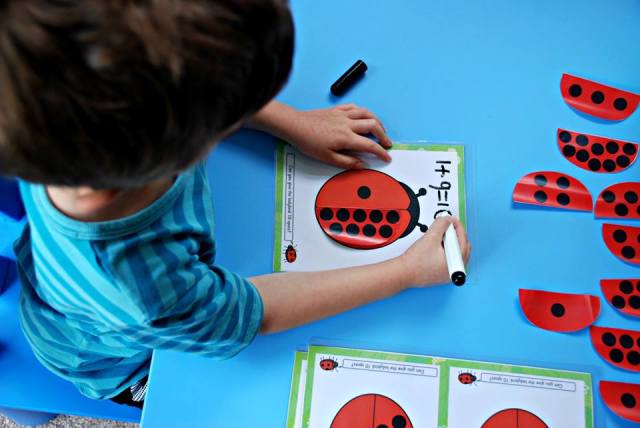
Free to download Ladybird Number bons activity from Twinkl

Practicing Number Bonds.  Lots and Lots of practice.  But I tried to find fun ways for the kids to do this – matching heart addition activity, butterfly and flower maths

We also used number lines quite a bit and got the kids comfortable with the idea of what adding would look like on a numbers line – hops.  There are lots of worksheets which show addition on a number line –addition to 10 using a numberline, addition up to 12 using a numberline.
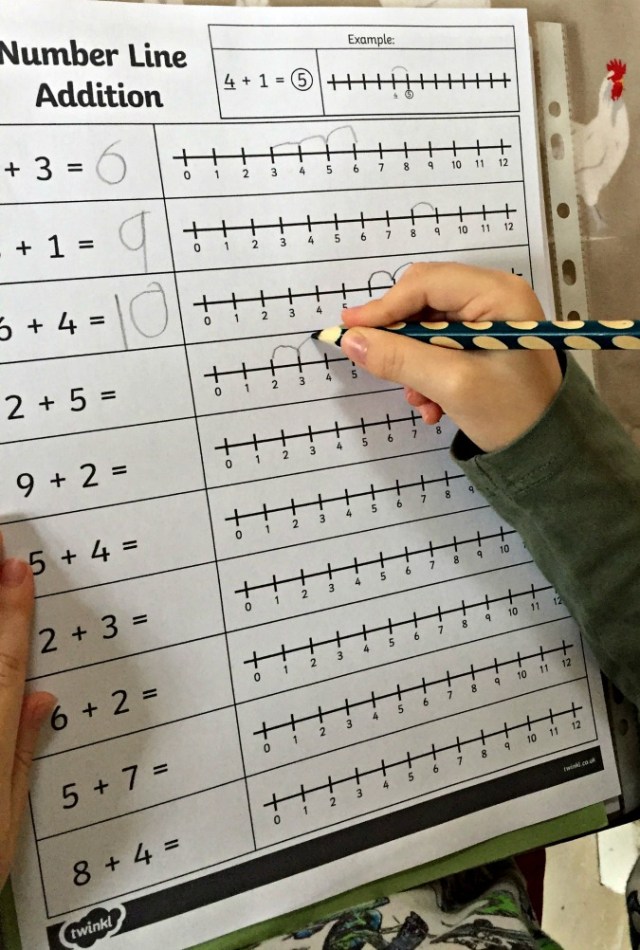
Numberline Addition page from Twinkl Resources website

Another great way of doing some of the repetitive maths practice is with the Cut and past worksheets.  Addition 7, 8,9 cut and stick activity (free)
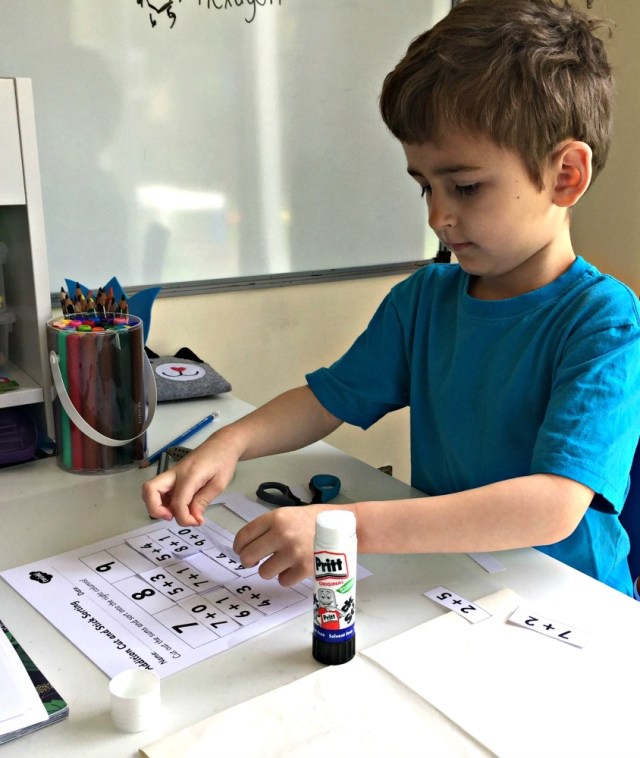
7, 8, 9 addition cut and stick activity free to download from Twinkl

Adding more than two numbers together.  There are a series of worksheets which you can use for this  (In the Twinkl search bar type in the words – adding three one digit numbers – eg Adding three one digit number using number facts, adding three one digit number numbers using doubles, (free) adding three one digit number adding the smallest numbers first. (free)

Column addition.  First lots of practice with basic adding in the column without any carrying.  You can start with adding 3 and 2 digit numbers no carrying (free) and then go onto adding 3 digit numbers no carrying

Column addition.  Introducing the idea of a carrying a number and then practicing it over and over. Adding three digit numbers with carrying (free)

While working on column addition we also did some missing number addition pages

Twinkl also create Year Addition and Subtraction workbooks which have a number of examples in them.  eg Year 3 addition and subtraction workbook or Year 4 addition and subtraction workbook

They have a wide selection of Maths worksheets and they are constantly adding more.  These are just a few of the ones that we have used.
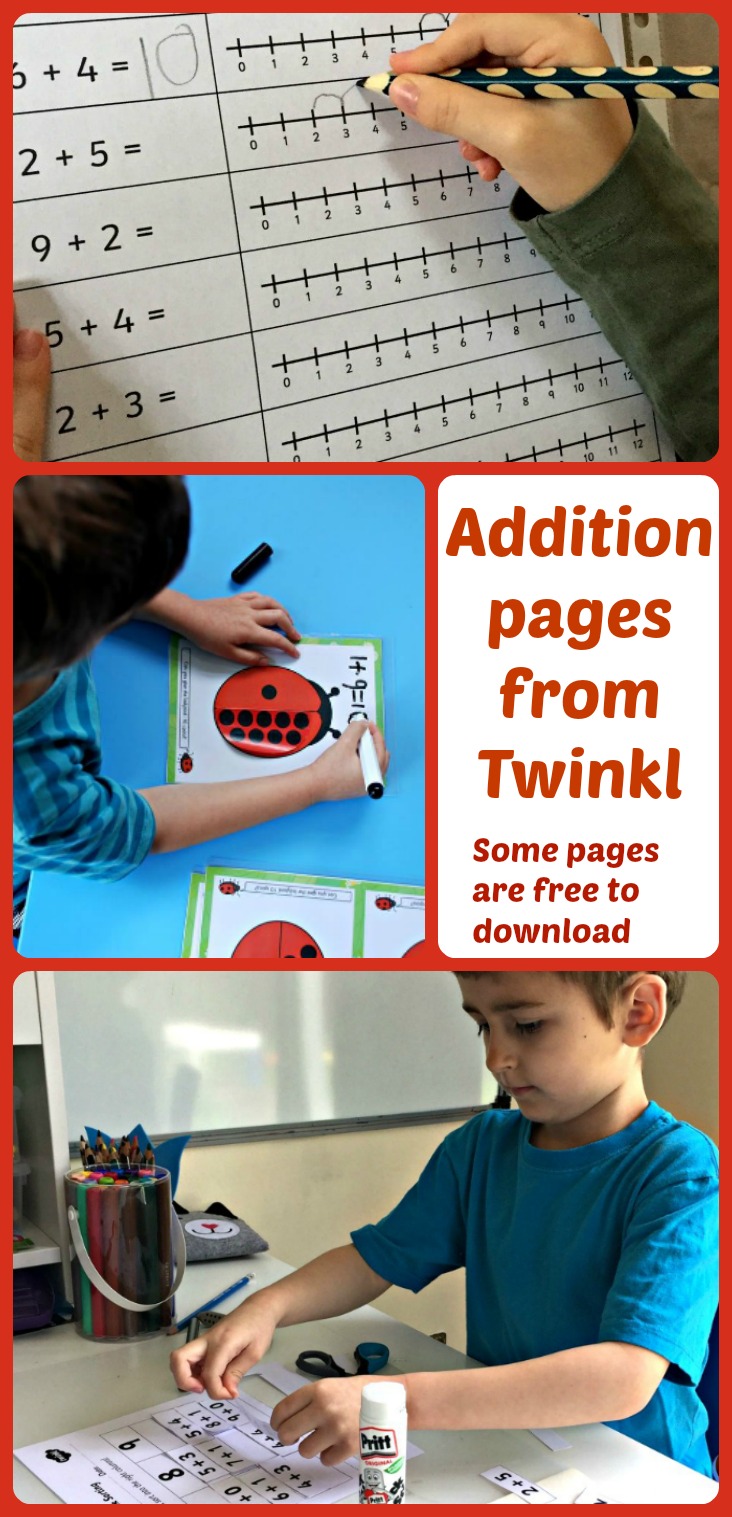
Addition pages from the Twinkl Resources website. Great for home educating families. Some pages are free to download

Save

Save

Save

Posted in maths ideas | Tagged , , , , , , | Leave a comment

Minibeast Crafting

We seem to have been doing a lot of Maths lately and not much crafting so last weekend I did a search to try to find something to inspire us.  I ended up printing out some basic Mininbeast  shadow stick puppets (from Twinkl) onto some crafting card and then just left them for the kids.  I actually did not have anything planned but I was hoping that the kids might get inspired.

Surprisingly the first thing they wanted to try was to decorate the templates with some of their decopatch paper.  I was surprised by this as my youngest is still not a fan of using glue (he still struggles with the feeling on his skin).  However the Minibeast theme inspired him.  He first tried the spider template but the legs were too fiddly and the glue was just going everywhere so he switched to doing a butterfly.

Creating a butterfly using the shadow stick puppet templates from Twinkl and some decopatch paper

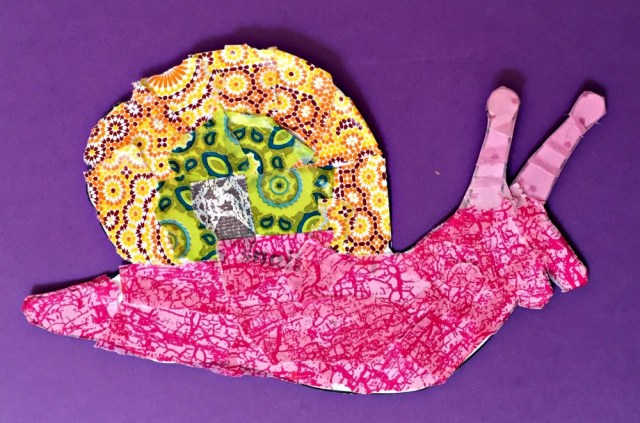
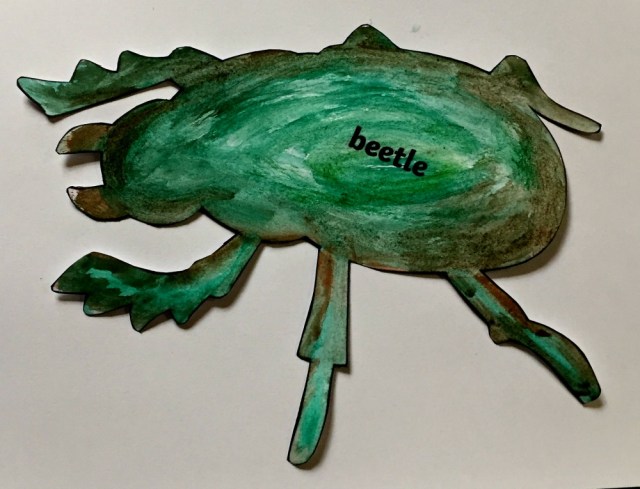
We stuck with the idea and the kids made a few more – the butterfly template was popular with the decopatch as the kids had fun creating patterns for the wings, also the snail was a winner and even a few beetles.

Decopatch Butterfly created using a shadow stick puppet template from Twinkl and some decopatch paper

Decopatch Snail created using a shadow stick puppet from Twinkl website and some decopatch paper

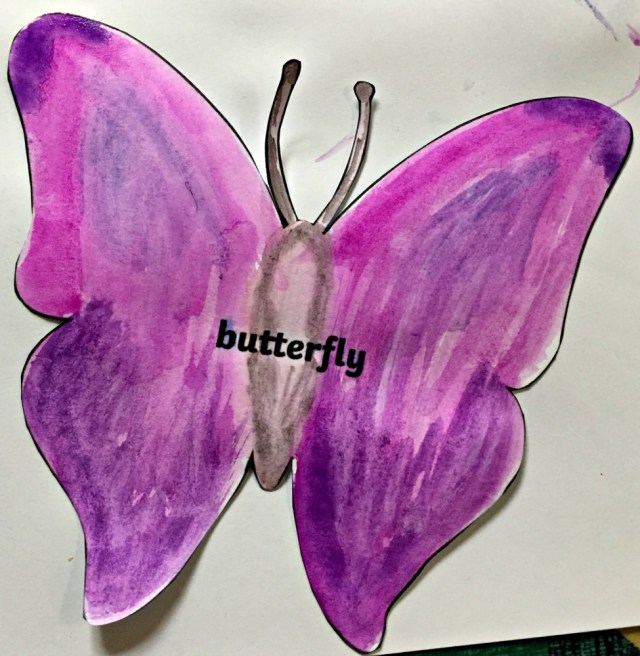
We had a few Minibeast templates left over which I forgot to pack away and the next day my daughter decided to try some more of her colour blending, this time using some water-colour paints and the left over templates.

Using the Shadow stick puppets to practice some colour blending

Simple but it ended up being a great painting activity for her.

Spider shadow stick puppet from twinkl painted using water colour paints

Easy Minibeasy art for children. Giving them basic shadow stick puppet outlines to paint

Sometimes I need to remind myself that as important as all the Maths is that we have been doing lately we still need to step back and spend some time being creative.  It does not need to be a complex craft project but it is so important to just relax, take sometime to unwind and have fun creating something.

Butterfly shadow stick puppet downloaded from Twinkl website and painted with some water-colours

For those of you in the UK – I tend to buy our decopatch paper from Baker Ross – they have a wide selection – decopatch paper selection

Easy Mininbeast craft using a shadow stick puppet template from Twinkl, water-colour paints or decopatch paper

Save

Save

Save

Save

Posted in Art and Craft Ideas | Tagged , , , , , , | 1 Comment

Nine Years

Nine years ago my oldest was born.  She challenged all my pre-existing ideas that I had about being a parent.  She is kind, gently, loving, protective, smart, funny, sensitive to other people’s needs, she is an incredible daughter and the most amazing big sister and Yes mixed in with all of that she also has SPD (sensory processing disorder).  But SPD does not define her.  It does not make her the person she is.  She is that amazing person even though she struggles with lots of everyday things that most people take for granted.

Her SPD does play a large part in our life.  It has changed the entire way we parent and they way our family works together.  It is the reason we chose to home-educate and it is the over-riding factor that influences how we structure the days and weeks.

But her SPD has also allowed her to be the amazing big sister that she is.  She understands her little brother better than anyone else and she will often remind me when I have missed something – “mom you are not noticing that piercing sound that is distressing us” (in case you do not read my blog her younger brother also has SPD).

We have come a long way in the nine years since she was born.  I have read a lot about SPD and we have worked with three brilliant Occupational Therapists who have helped both the kids and me deal with how SPD affects them.  But although she is managing so much better the truth is she will always have SPD.  It is not going to go away. She will get better at dealing with situations but it is going to stay there a part of the unique combination that makes her who she is.

We will continue to find more ways to help her, that will never stop.  What I have come to realise is that I need to change my attitude towards SPD.  As much as there are days when I HATE that they have SPD and I still cry about it I need to help them view it as positive so that as they both grow older they do not become ashamed by it.

As much as I want my daughter to do have good body image I also want her to have good mental health and for her that means accepting that SPD is a part of her and that it is not a negative thing.  I need to let go of the final twinges that I have, the final little thoughts that linger because my kids may not fit the typical “normal ” kid criteria but that is just FINE with me.

We have two kids with SPD and they are AMAZING !!!

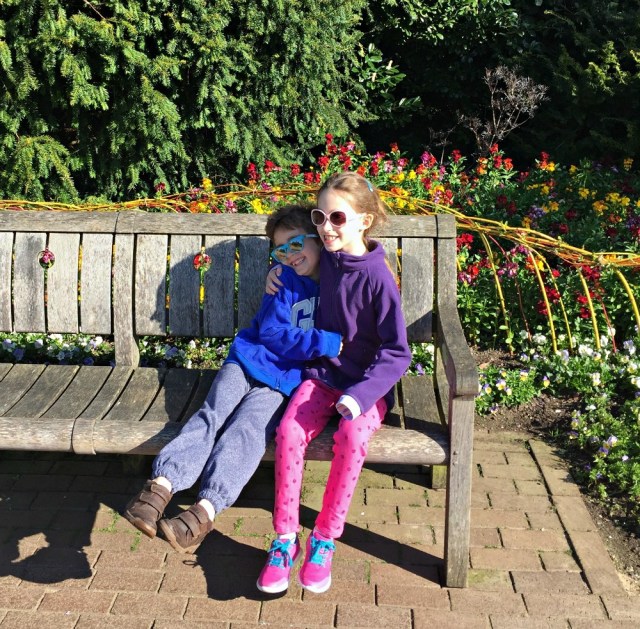
Kids at Wisley Gardens

Save

Save

Posted in SPD | Tagged , , , , | 3 Comments

Mathlink Cubes Set – a great Maths set for early ages

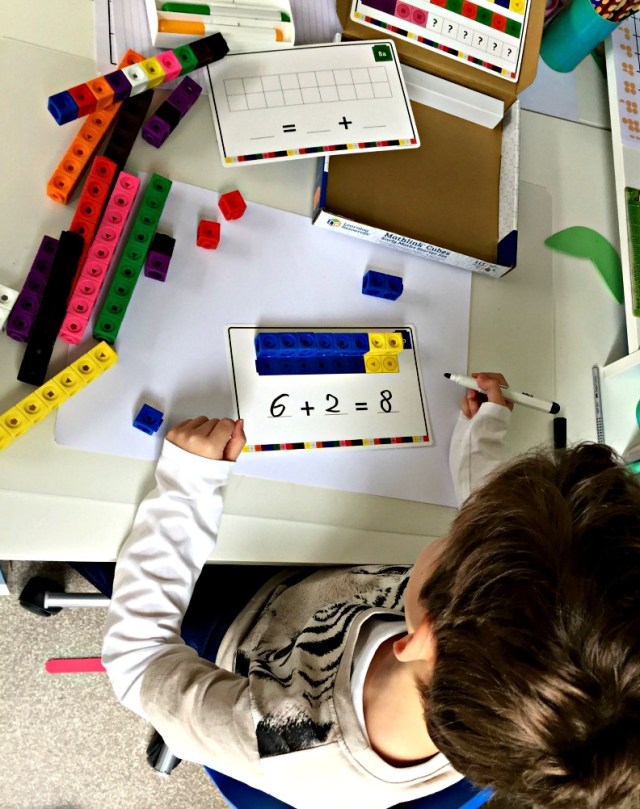
We have had our snap cubes for over four years now and we love them, so when Learning Resources asked if we would like to test out the Mathlink Cubes Activity Set I immediately agreed.

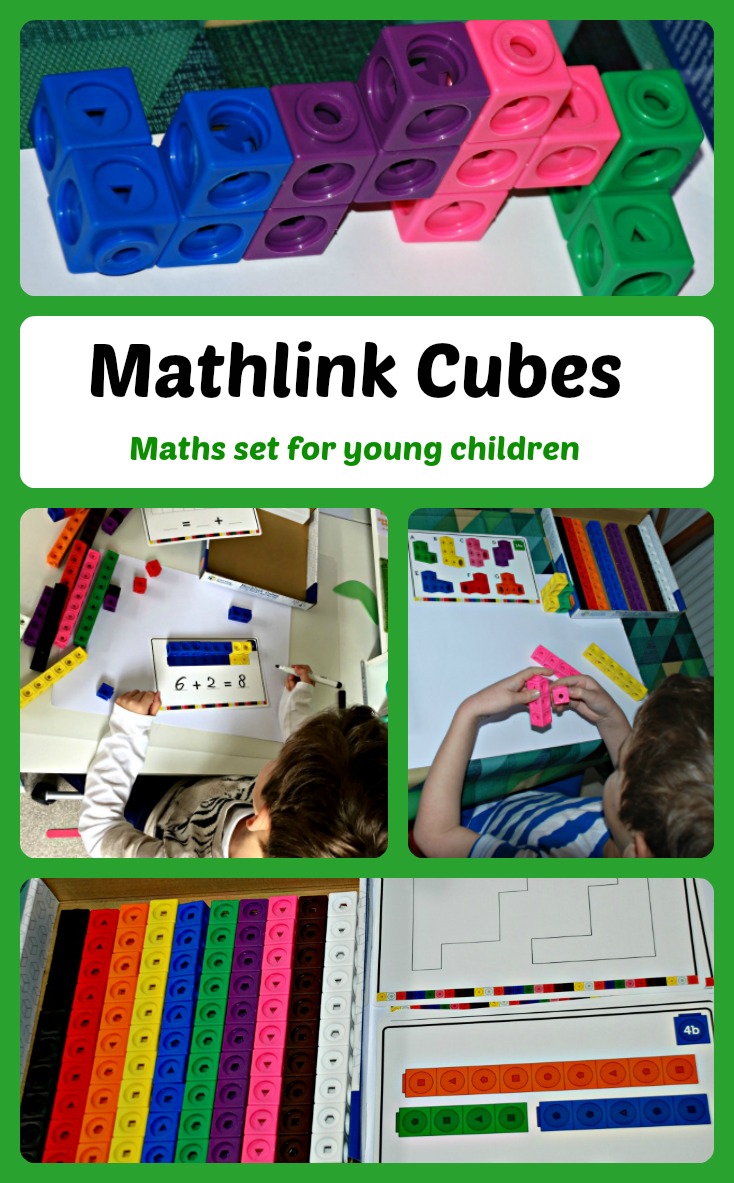
Mathlink Cube Starter Set from Learning Resources includes 100 cubes and 15 double sided activity cards

My initial thought was snap cubes with activity cards but my youngest immediately pointed out that each cube had a shape on each of its four sides so in his opinion they were better than his snap cubes.  The simple inclusion of the shapes on the sides of the cubes was a big winner for my son because he likes to be precise, so while he is working with the cubes he will make it that all the triangles face a certain way or that there is a pattern with the shapes, for him it makes the cubes more interesting, which means he happily sits for longer periods of time.

The photo below is what the Mathlink Cubes look like compared to our normal snap cubes (our snap cubes do look a bit scratched and more “well-used” in the photo but that is because we have had them for over 4 years and we have used them A LOT ).

Mathlink cubes verses snap cubes both products are maths manipulatives

The mathlink cubes are split into 10 different colour groups (10 cubes in each colour) and the set comes with 15 double-sided activity cards.

Mathlink Cubes Start set includes 15 different activity cards which include addition, subtraction, patterns and shapes

The cards start with basic patterns, addition, subtraction and work up introducing division and creating 3D shapes.  And in case you are wondering you can use white board marker pens on the cards as they wipe off perfectly.

Mathlink Cub starter set. Using the activity cards to create some 3D shapes

For me the activity cards are a starting point.  Something for my son to use, to get an idea and then hopefully he will expand on the idea himself.  A great example was the 3D shape activity cards.  After building the shapes on the card both my kids actually sat down and created some of their own shapes and also tried to find different ways of combining the shapes together.

Mathlink Cubes starter set, you can snap the cubes together to build interesting shapes

This is why we have always liked snap cubes, the kids enjoy playing them, they make Maths fun and this Mathlink set for me is snap cubes improved.  It is the same maths manipulative that I like using but with the added bonus of the extra shapes on the sides of the cubes and the extra the activity cards.

My son did comment that the cubes were slightly harder to take apart and click into place but it did not deter him and total honest mom moment I actually liked the fact that it was slightly harder for him to work with the cubes as it ended up being a great finger strengthening exercise.

Mathlink Cubes A Maths set for younger children which helps them understand some basic maths principles

I was sent the Mathlink Cubes Early Maths start set by Learning Resources in exchange for me  completing a questionnaire on the set.

Save

Save

Save

Posted in Home education resources | Tagged , , , , , | 2 Comments

Equations

Over the weekend my daughter and her dad got into a conversation about equations and how what is on the one side always balances with the other side.  She actually jumped onto the idea and ended up asking more and more questions.  I was so impressed how a chat between father and daughter ended up being this amazing Maths session.

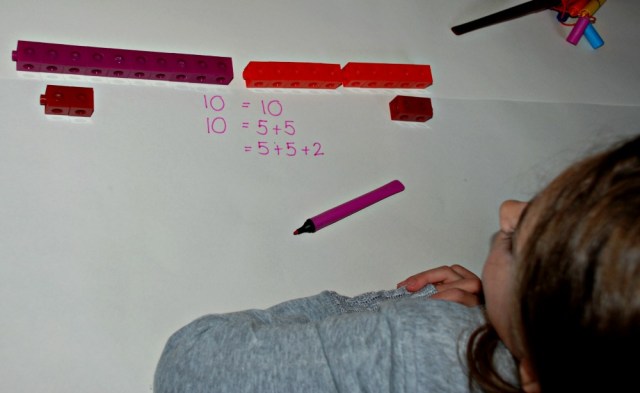
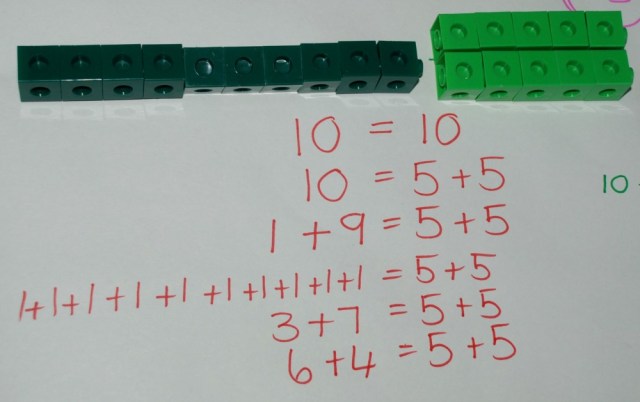
So this week I thought it would be good to go over the equation chat with her and use some visual tools just to make sure she really understood everything.  We started off really simple.  10 snap cubes = 10 snap cubes.  So if we add 2 more snap cubes onto side of the equation is it still balanced ?  If not what do we need to do ?  We need to add 2 snap cubes on the other side as well.

Equations. Always keep both sides balanced, if you add 2 to one side add it the other aswell

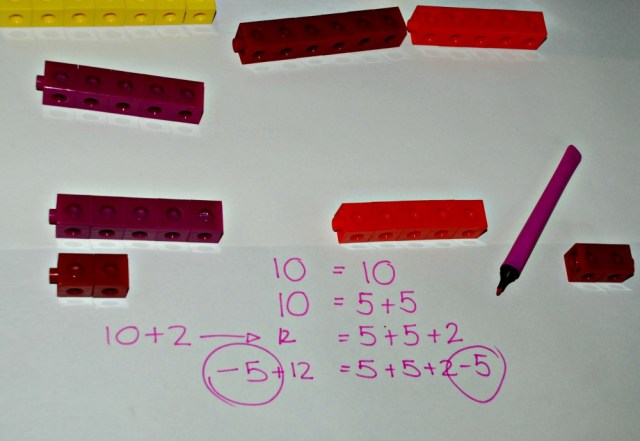
What if we subtracted 5 snap cubes from one side ?  Do the two side still match ?  No so we need to subtract 5 from the other side as well.

Equations with snap cubes. Making sure what we do to the one side we always do to the other side

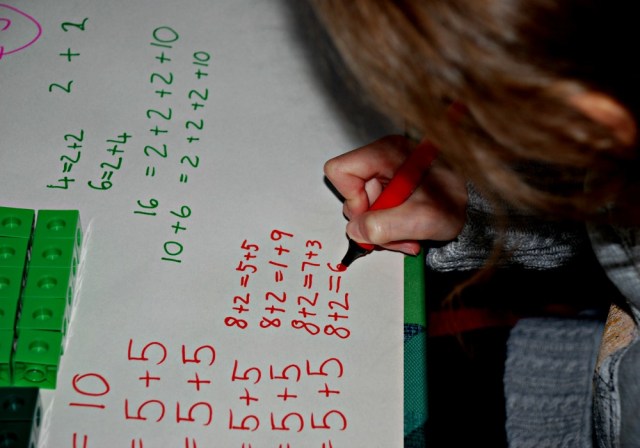
Keeping with the idea that the two sides must always be balanced we then broke it down into sums.  Instead of saying 10 = 10 how else can we represent it.  If 10 = 5 + 5 and if 10 = 8+2 then we can also say 5+5 =8+2.  Are the two sides still balanced ?  Does it make a difference if we write a total or a sum ?

Equations. expanding a sum and showing different ways of writing it out

She quickly branched off and created a whole series of equations showing which two sums can be equal.  According to my daughter what makes the most sense for her is when we speak about balancing the two sides (like a see-saw what is on one side must be the same as the other side so that see-saw is balanced.  If one side is more than the see-saw would not be balanced).

Equations. Always keeping the two side balanced

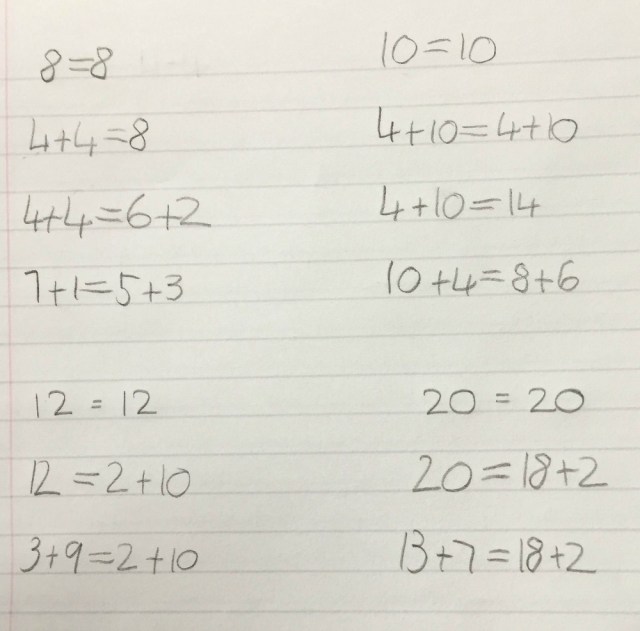
And last night I noticed a few pieces of paper on her desk all with different equations on.  Equations that she had written out just because she wanted too, no-one asked, it was not part of any “learning activity” I had set.  She was just practicing writing out some equations.

Writing out Equations

I am thrilled that she is starting to see Maths as something that she can understand.

Save

Save

Posted in maths ideas | Tagged , , , , , | 2 Comments