Anglo-Saxon Kings

My daughter likes creating family trees and timelines showing how the different Kings and Queens are related.  She has actually created one massive timeline of all the Kings and Queens of Britain but now that we have been looking at the Anglo-Saxons in more detail we thought we would revisit just the Anglo-Saxon section and redo it so we could include some additional details.

Nothing fancy just 2 large pieces of A3 paper with our pencils and some resources that we have already been using.  My daughter was focusing on getting the order of the Kings with the years they ruled and how they were related / linked to previous Kings.
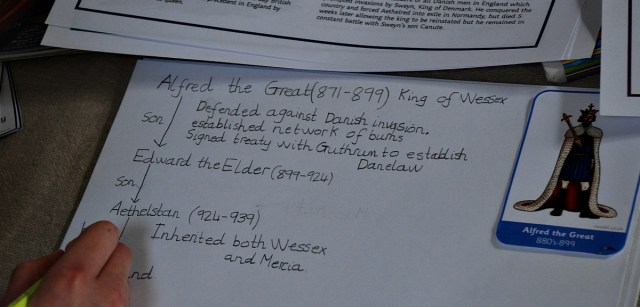
Creating her own List of Anglo-Saxon Kings including some signifcant details

She did also include some extra details around the significant Monarchs (the ones she considers significant) –  so she was very interested in Athelred the Unready and Cnut because they both married Emma and Emma had 4 sons. all of whom got a turn to rule.  She finds these more unusual occurrences very interesting.

Creating her own timeline of the Anglo-Saxon Kings of England

After she had finished she decided to add a bit of colour – mainly highlighting some of the Kings in Red.

A section of the home-made Anglo-Saxon Kings timeline. Part of our British History

All in all I must admit it turned out to be a very useful summary of the Anglo-Saxon Kings.

This slideshow requires JavaScript.

Regarding the sources she used – she really stuck to two sources for most of it.  The British Monarchs Timeline pages from Twinkl Resources (this is one of their secondary resources)- this lists all the Kings and Queens from the Anglo-Saxons through to the current Queen.  We are finding these pages very useful for British History.

This slideshow requires JavaScript.

And although it does include some facts about the different Kings and Queens we could not always find the family links that we wanted (ie a certain Kings was a half-brother or a nephew of a previous King etc) so we combined the Twinkl pages with this book Early Kings of England: Band 14/Ruby (Collins Big Cat).  This book has been such a gem for us.  It is a reader aimed at Key Stage 2 ages so it is not complex as such but it includes a fair bit about the significant Anglo-Saxon Kings, their accomplishments and family links.

This slideshow requires JavaScript.

We really liked details like this family tree for Alfred the Great.
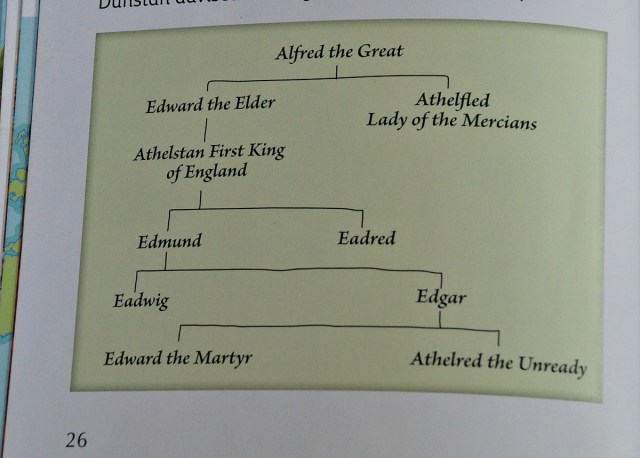
A family Tree included in the Collins BIG CAT reader Eralt Kings of England. Brilliant Anglo-Saxon source for Key Stage 2 ages

My daughter did also use two pictures – one of Alfred The Great and one of William the Conqueror which are part of the Significant British Monarchs Flashcards from Twinkl Resources.  And the Anglo-Saxon timeline on the board where she is working is also from Twinkl Resources
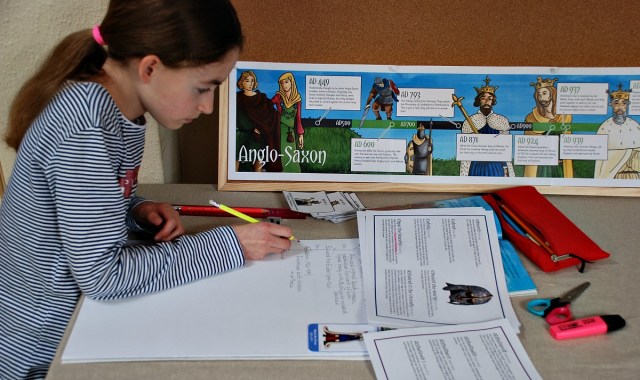
creating her Anglo-Saxon Monarchs Timeline using Twinkl Resources pages

All Twinkl Resources items are part of their paid for membership

I do include Affiliate links. If you follow an affiliate link and go on to purchase that product, I will be paid a very small commission, however your cost will remain the same. I only include affiliate links for products that we use and love.

Working on her Anglo-Saxon Kings timeline using resources from Twinkl and a BIG CAT reader on Early Kings on England

Posted in History | Tagged , , , , , , , | 4 Comments

Winter of the Wolves – Anglo-Saxon Fiction

I recently mentioned that my kids have become fascinated by the Anglo-Saxon time period.  And if there is one thing I learnt last year it was the power of finding good Historical Fiction books for the kids to read.  A good fictional story set in the time period they are learning about can really bring that period to life for the kids.

Yes, Historical Fiction books are not going to be 100% accurate in that the characters are fictional and no-one knows word for word what happened when a certain battle or event occurred.  But when a story is set in a time period and the author has truly done their homework about that time period the kids absorb a vast amount of knowledge without even realizing it.  And I have found because it is knowledge linked to a story that they enjoy it really sinks in and stays.  Oh and the vocab, wow the vocab that they pick up reading historical fiction is amazing.  So Historical Fiction for me, is win win win!!

We’ve just finished our first Anglo-Sazon Historical Fiction book and it was brilliant.  Winter of the Wolves: The Anglo-Saxon Age is Dawning written by Tony Bradman. The story is about a boy called Oslaf (an Angle) who loses his parents and needs to fend for himself.  So he goes to a new village (the chieftain’s wife was an old friend of his mothers) and asks them to take him in.  They do take him in but he is told he needs to earn his keep by becoming a useful member of the village.
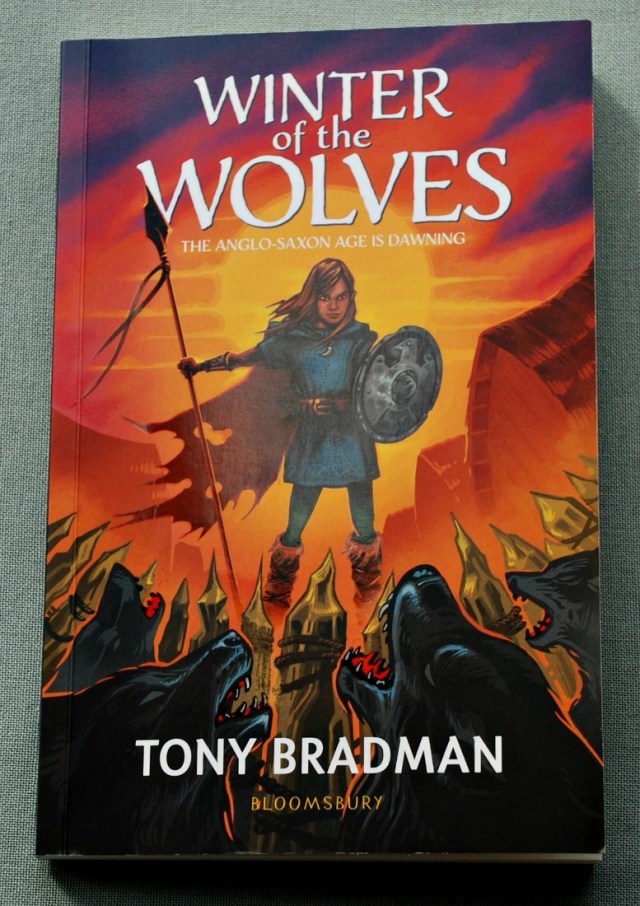
Winter of the Wolves by Tony Bradman. A Historical Fiction story for kids to read. All about the Anglo-Saxon period

The story follows Oslaf as he finds his way, including becoming close to the local scop, learning to be a warrior and then embarking on the voyage with the townsfolk to new land in Britain.  I don’t want to give too much of the story away.

This slideshow requires JavaScript.

But a couple of things.  Both my kids were really rooting for Oslaf – they really were it was quite something.  They were talking about what he needed to do to survive, really getting involved with the character.  I will admit in the beginning I was worried it might be a little slow going but that was really just me.  From the start my kids were hooked and wanted to find out what was coming next.  From the way the village was set up to the actual migration, to getting to Britain, trying to settle and being drawn into battles.  The whole way through the kids wanted to find out how Oslaf was coping and what would be the next challenge that he faced.

They do use some words that are not common in English today like scop or wyrd – but there is a glossary at the back that explains them and really by the end of the story both my kids knew exactly what those words meant.

The book also includes a 5 page Historical Note at the back which is very handy – it sets out the background and explains a few facts about that time.  We actually turned and read the historical note after reading the first chapter as it does set a good grounding, so I would advise you not to leave it until the end of the book.  I think it helps the kids to understanding the setting of the story.

The story itself is 140 pages, there are no pictures/illustrations in the story but my kids did not comment on that once.  We read it as a family book (that means I read the story while both kids sat next to me and followed along).  But both my kids (aged 8 and 10) would have been capable of reading it by themselves, we happen to enjoy family reading because then we also talk a lot about what we are reading together.

Also I do need to mention this is set in the Anglo-Saxon time so there is fighting but it was not gruesome.  And both my kids accepted that Oslaf going to fight was part of being a boy in that time period.

If you are looking for a fictional story in the Anglo-Saxon times I would recommend this book.  I do think by reading this story the kids will discover a lot of interesting facts about the life of that time and what would have happened when the tribes migrated to Britain.

We are moving onto the The First King of England: The Story of Athelstan (Flashbacks) next but I have been so impressed with this author that once we have finished our next few stories that are waiting for us I am going to search for his other books.  I spotted he has also written Attack of the Vikings (Flashbacks) and Revolt Against the Romans (Flashbacks)and we are definitely going to give both a try.
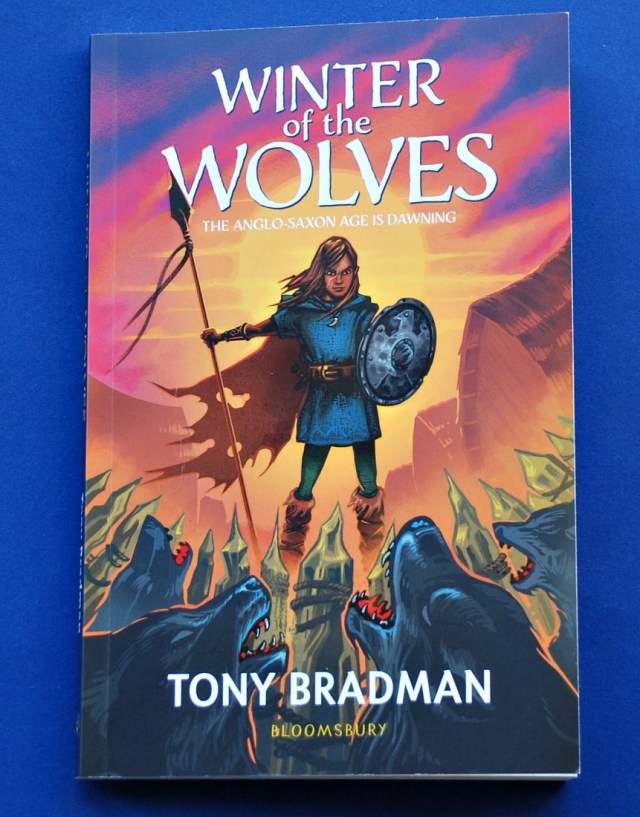
Admin – The publishers knew that my kids were looking for Historical Fiction books set in this time period and asked if we would be interested in receiving this book together with a few others.  Opinions expressed in this are mine and my two smaller readers.

I do include Affiliate links. If you follow an affiliate link and go on to purchase that product, I will be paid a very small commission, however your cost will remain the same. I only include affiliate links for products that we use and love.

Winter of the Wolves by Tony Bradman. The Anglo-Saxon Age is Dawning. Prefect Historical Fiction book for kids to read while learning about the Anglo-Saxons

Posted in Book Ideas | Tagged , , , , , , | 2 Comments

Forces Topic pack

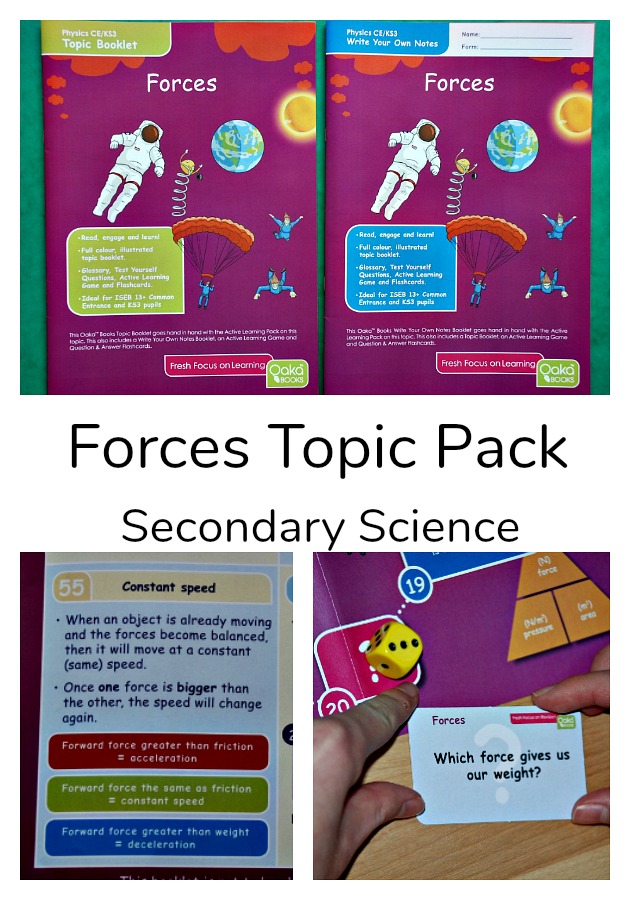
My youngest (eight-years old) has been revisiting Forces, well, I am not sure how much he actually remembers, so revisiting might not be the most accurate word.  But he has been rereading our Feel the force book and working through a workbook.  His sister also wanted to join in but the Forces workbook was too simplistic for her, she needed to take a step up.  So instead she been using the Forces Topic Pack from Oaka Books.

Now just to clear up any confusion before I go further.  The Forces Topic pack is designed for Secondary years – it says very clearly on the books – KS3 and my daughter would still be in Key Stage 2 if she was attending school.  But we like to follow interests and don’t stick to the idea that they can only learn about something in a certain year. So we were not too fussed by it being categorized as Key Stage 3.

Also my daughter is what I call a Visual Learner.  What do I mean by this ?  If we just sit and discuss a topic she will often get a lost.  However if I just get a piece of paper and start using diagrams / almost family tree like structures to explain she follows, understands the concepts and starts asking questions.  And she is becoming a very independent learner.  So once she understands some basics she will often sit and extend her own learning – she will find books about the topic, reasearch on the internet (please don’t worry we monitor the internet and are aware of what is out there).  Her Visual Learning style is why we like the topic packs – they are broken down into key points, with pictures and diagrams explaining the points.

This slideshow requires JavaScript.

We tend to read sections of the Topic Booklet, chat about what we read, sometimes do some practical activities (like work with our magnets) and then she has a go at the Write Your Own Notes or even writes her very own version of Notes in her own book.

This slideshow requires JavaScript.

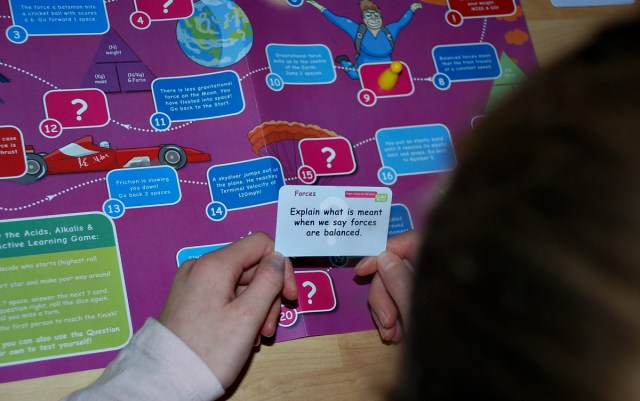
I don’t like to rush her through the Topic Pack as she really does like to expand on sections herself and we like to encourage that.  But we do play the board game that comes with the set even before we have finished reading the Topic Booklet.  And it works well for us.  I do go and filter out some the question cards so that we only have the questions for the sections that we have already covered.  And my daughter is not a BIG board game player, so we don’t play for long stretches of time but I do find it is a useful extra.  And the added bonus is it highlights any areas that she might not understand properly.

This slideshow requires JavaScript.

So the details –  what is included – the Topic Pack is 1 Topic Booklet, 1 Write Your own Notes and 1 Learning Game.

The Forces Topic Pack covers – what is a force, different types of forces, Gravitational Force, Magnetic Force, Friction, Air resistance, balancing forces and some calculations. (And it also includes a very useful Glossary of terms)

I like the Topic Packs because the it is Key Points and the kids don’t get overwhelmed with long confusing paragraphs.  I think of the topic packs as the foundation for the kids – so they get a good understanding and then they can branch out and investigate / reasearch further if they like.  But the foundation is there.

Admin Bit – We went sent a parcel of goodies from Oaka Books earlier in the year.  It was up to us what we used / how we used it / when we used it and what we thought of it.  One of the reasons I was happy to get the parcel in the first place was because we have already used 2 of their Key Stage 2 Topic Packs and played one of their games before and I liked the style so I was expecting more of the same.  Which is exactly what we got.

Using the Forces Learning Game which is included in the Oaka Books Forces Topic pack


Forces Topic pack by Oaka Books. A secondary science learning pack. Great for home education

Posted in Science Ideas | Tagged , , , , , , , | Leave a comment

Spelling Workbook

My son definitely needs a bit more guidance with spelling compared to his older sister.  She just seems to get the sounds and spelling rules and exceptions quickly whereas I am noticing more and more with him that he needs more practice and more explanation – he finds all the exceptions a bit frustrating as he wants to be able to apply a spelling rule and be done with it.

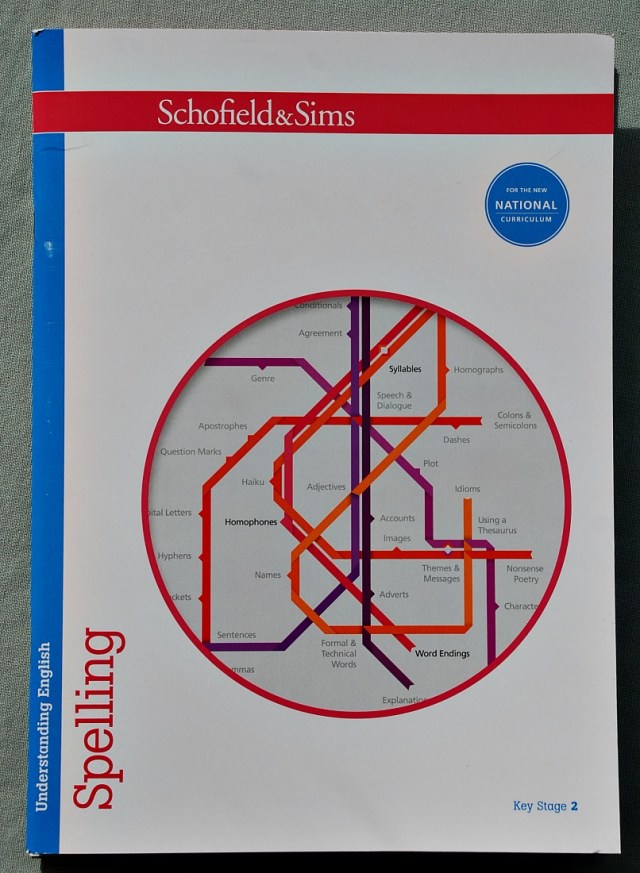
So we are adding more spelling activities to our normally weekly learning activities.  I wanted a workbook that we could do together, slowly, something that could guide me and give me rules and exceptions that I could then work on with my son.  Since I have been so impressed with the Understanding Maths Range of workbooks by Schofield & Sims I thought I would try their Understanding English: Spelling : KS2 English Study Book, Ages 7-11.  Now we are just starting with this workbook and like I said we are working through it slowly because I often find when we do an exercise I then end up thinking about another spelling activity that is linked so we do that as well.  So it is not a straight forward just sticking to the workbook plan it is more using the workbook to give us guidance and point us in the right direction.  But it seems to be helping.
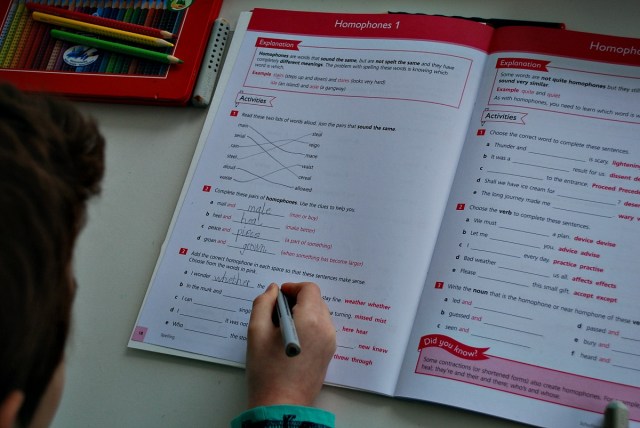
Working is the Schofield & Sims Understanding English Spelling workbook

As I often see queries about spelling resources I am going to list what is included and share some photos (like I said still early days for us but so far it is proving to be a useful workbook for us).

It is aimed at Key Stage 2 ages so there is an assumption that the kids already know the sounds and  few basics rules.

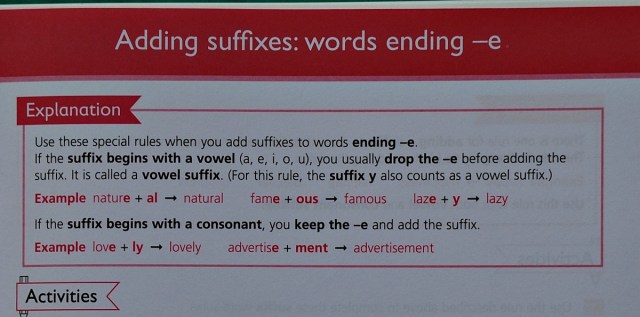
At the top of every page has a brief explanation with examples which is then followed by exercises for the kids to do – we have found that sometimes the exercises given are enough and other times I need to create more examples for him.

Understanding English Spelling workbook. An example of the explanations included at the top of each page

So what is covered (37 pages of activities excluding the answers at the back)

  • syllables
  • Tricky words / unusual spellings
  • word endings – le, el, al, ol
  • Soft and hard sounds
  • silent letters
  • ie or ei
  • Homophones
  • adding s and ed
  • adding ed and ing
  • prefixes – un, mis, re, im,
  • suffixes – including when words end with an e and y and exception to the rules
  • word structure and word families
  • word endings – tion, sion, ssion, cian, able, ible, tious, cious, tial, cial

This slideshow requires JavaScript.

This is not a sponsored post and it is not a gifted item.  I bought this to assist my son with his spelling.

I do include Affiliate links. If you follow an affiliate link and go on to purchase that product, I will be paid a very small commission, however your cost will remain the same. I only include affiliate links for products that we use and love.

Schofield & Sims Understanding English Spelling workbook. An english range of workbooks for Key Stage 2 ages

Posted in Homeschooling | Tagged , , , , , , | 1 Comment

Anglo-Saxon Maps

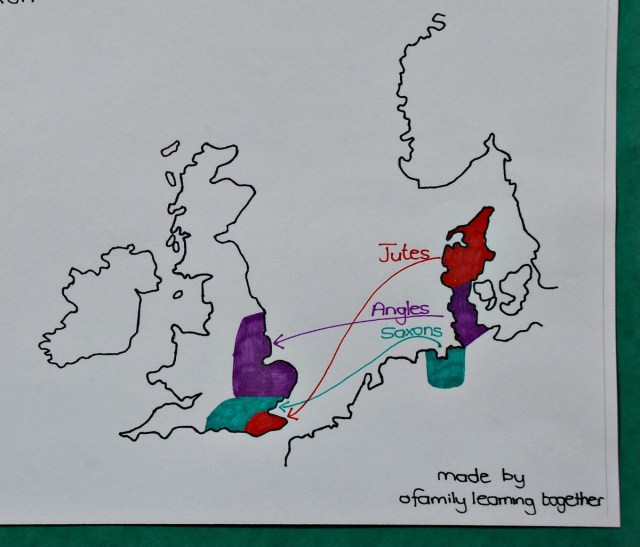
We are started reading some Anglo-Saxon Factual Fiction Books.  We are loving them but both my kids started getting a bit confused by the different characters and where they came from (something that is very important for my son to understand or he gets frustrated with the stories).  So we started looking at where the Jutes, Saxons and Angles originally came from and which areas they settled in.  While we were doing this my daughter decided it would be good to have a map showing all of this so we created one – nothing fancy – just hand-drawn but it clearly shows the different groups, the areas they came from and where the initially settled.

Free to download hand-drawn Anglo-Saxon England map showing the Jutes, Saxons and Angles Migration

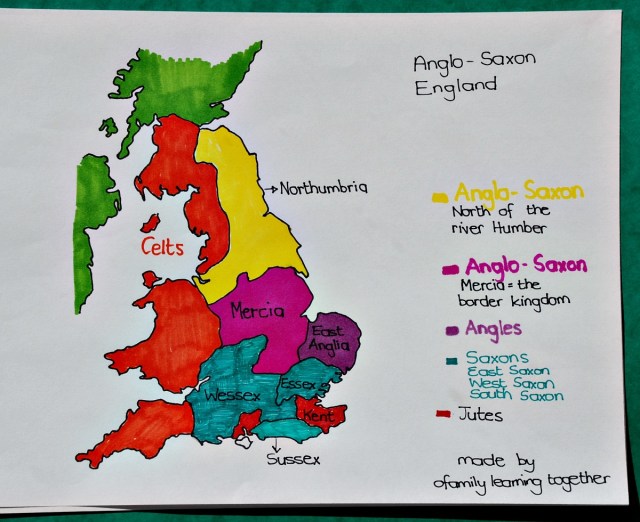
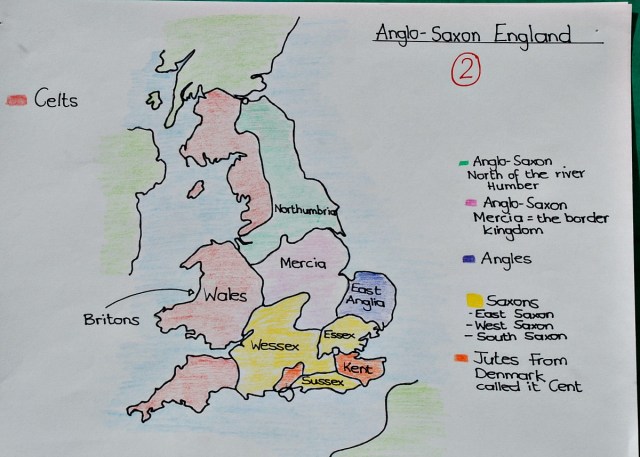
Then we got onto how they started dispersing, pushing the Celts back and forming their own territories / kingdoms, so again we decided a map was needed and we came up with this one – also a hand-drawn map (we actually have 2 different versions of this one).

Map of the Anglo-Saxon Kingdoms of England. Free to download hand-drawn by ofamilylearningtogether.com

The different Kingdoms of Anglo-Saxon England. Free to download hand-drawn map by ofamilylearningtogether.com

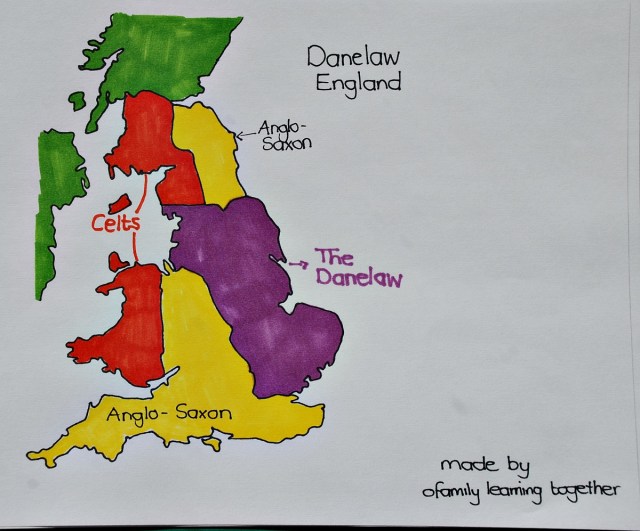
That was really where our factual fiction books stopped with the different Anglo-Saxons kingdoms but of course we had started researching this so we continued and read up about Danelaw – and you guessed it required a third map.

Map of Anglo-Saxon England showing the Danelaw area. Free to download and hand-drawn by ofamilylearningtogether.com

We are actually creating a Anglo-Saxon board in our lounge area just because that is where we tend to sit when we read our books.  And even though the maps are created by my daughter and myself and are hand drawn I must admit it is helpful having them up as the kids can keep referring back to them.

I am going to leave the PDF files with the maps here in case anyone else wants a visual reminder.

Anglo-Saxon England map showing where the Jutes, Saxons and Angles came from

Map of the Anglo-Saxon England Kingdoms

2nd map of Anglo-Saxon England

Map of Anglo-Saxon England showing the Danelaw.

Also we created blank maps because my daughter wanted to “test” herself and see if she could remember everything so I am attaching the PDF of those blank map templates aswell.

This slideshow requires JavaScript.

They are NOT fancy and are Hand-drawn but I know sometimes it can get frustrating when you are looking for a FREE download for home education and you can’t find anything.

Blank Anglo-Saxon Migration (1)

Blank Map of the Anglo-Saxon Kingdoms

Blank map of the Anglo-Saxon Danelaw


If you are busy learning about the Anglo-Saxons you might enjoy these books – Shield Maiden and the First King of England


Posted in Homeschooling | Tagged , , , , , , | 9 Comments