The Story of the First World War for Children – book review

Anyone who reads our blog probably knows by now that we LOVE history but I have admitted before that the World Wars are something that I have not really jumped into just because I was worried about the content and my kids are sensitive kids. However both my kids are interested in the World Wars and we have started to deal with them so I have been searching for what I consider appropriate resources – resources that are factually accurate, not missing crucial facts but at the same time not too graphic and nightmare inducing. And I have found two books which I think fit the bill perfectly – The Story of the First World War for Children (1914-1918) and The Story of the Second World War for Children.

The Story of the First World War for Children by Carlton Kids

I have already written a post about the Story of the Second World War book so this is going to be our review of the Story of the First World War Book.

This is a book that has been written for Kids (recommended age 10+) and there are no gory, graphic pictures in it. However it is a book dealing with war so there is no getting around the fact that people died and where badly injured. But to give anyone concerned about content these are two examples of what I considered the most “graphic” of the photos (so not bad and neither of my kids commented about anything in the book being scary).

This slideshow requires JavaScript.

The book has been laid out in an easy to read style – a topic over a double page, with shortish paragraphs and good images.

This slideshow requires JavaScript.

So what exactly is covered by the book (sorry if this is a bit of a list but I know lots of people want to know the detail of what is covered)

  • Europe Divided (Introducing the climate for the start of the war)
  • Gearing Up for War (The arms race)
  • The Peace is shattered (The assassination and I really liked the detail here, they mention the failed bomb attack and that the assassination occurred on the drive to the hospital after the driver took a wrong turn – we like this type of detail)
  • Europe goes to war
  • The British Army (We liked these pages where it gives the kids a better understanding of the differences between the different armed forces)
  • The fighting begins
  • The Eastern Front
  • The Western Front
  • The French Army (similar to the British Army page, we liked this breakdown)
  • Digging In
  • Trench Warfare
  • The Great Guns (my son likes learning about the different weapons so this was a good starting point but he does like going into more detail)
  • The Germany Army (again like the British and French army pages)
  • The Gallipoli Campaign (I like that they talk about the significant battles and events and introduce the names and events and don’t leave this detail out)
  • The War at Sea
  • War in Africa
  • Chemical Warfare (this can be a sensitive issue but I think they handled it well)
  • Italy enters the war
  • War in the Air
  • 1016 a Bar of Battles
  • The first tanks (popular with my son)
  • America joins the war (again I liked that they included the detail about the Germany trying to plot with Mexico)
  • 1017 No end in sight
  • War in the Desert
  • Women at War
  • 1918 The last Great Battles
  • 1918 the war ends
  • Animals at War (we liked that they included sections like this)
  • Legacy of War
  • The Art of war (I love that they included images of war posters)

This slideshow requires JavaScript.

I am really impressed with this book.  We have read it cover to cover and have found it informative but not scary.  It covers a lot and yes there are areas where we are going to go back to and go into more detail but if you are looking for a World War 1 book that covers all major issues and is appropriate for kids then I highly recommend this one. (And just to clarify my kids are aged 8 and 11 and although we read this book together my eight year also read it to himself without any issues).
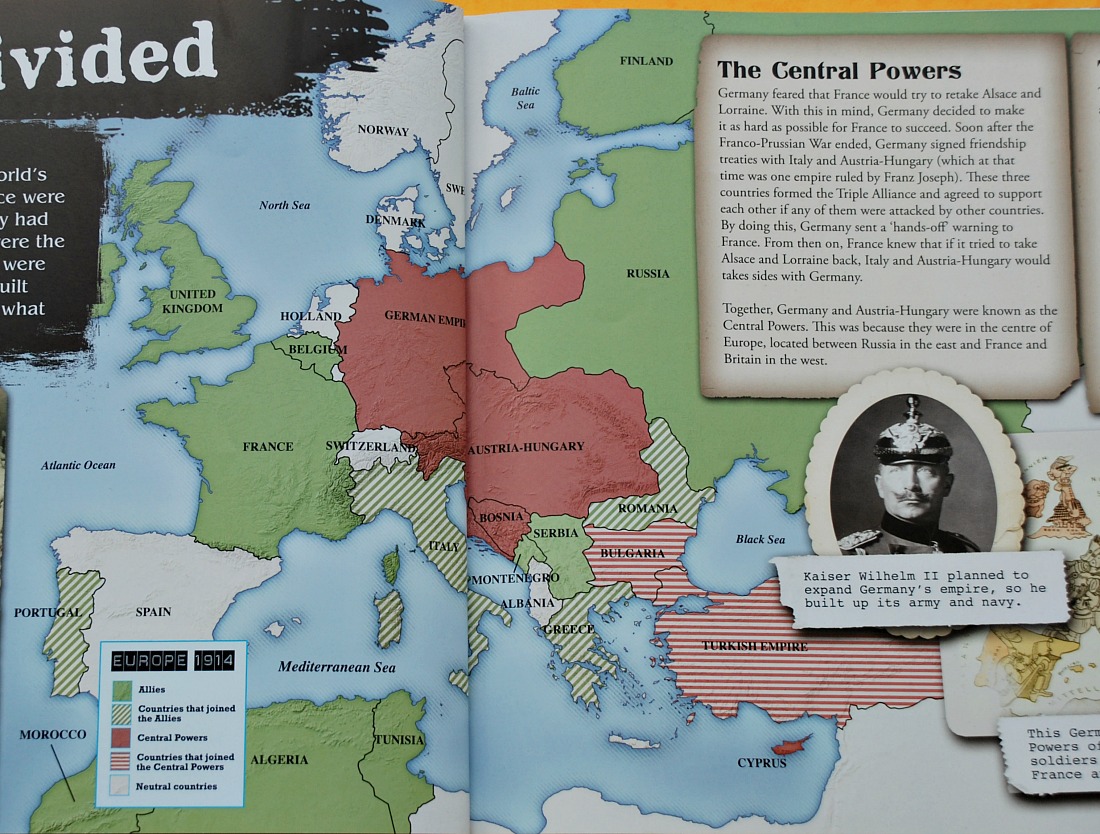
The Story of the First world war for children. Map of Europe

I do include Affiliate links. If you follow an affiliate link and go on to purchase that product, I will be paid a very small commission, however your cost will remain the same. I only include affiliate links for products that we use and love.
Posted in Homeschooling | Tagged , , , , , | 2 Comments

7 Times Table Dominoes

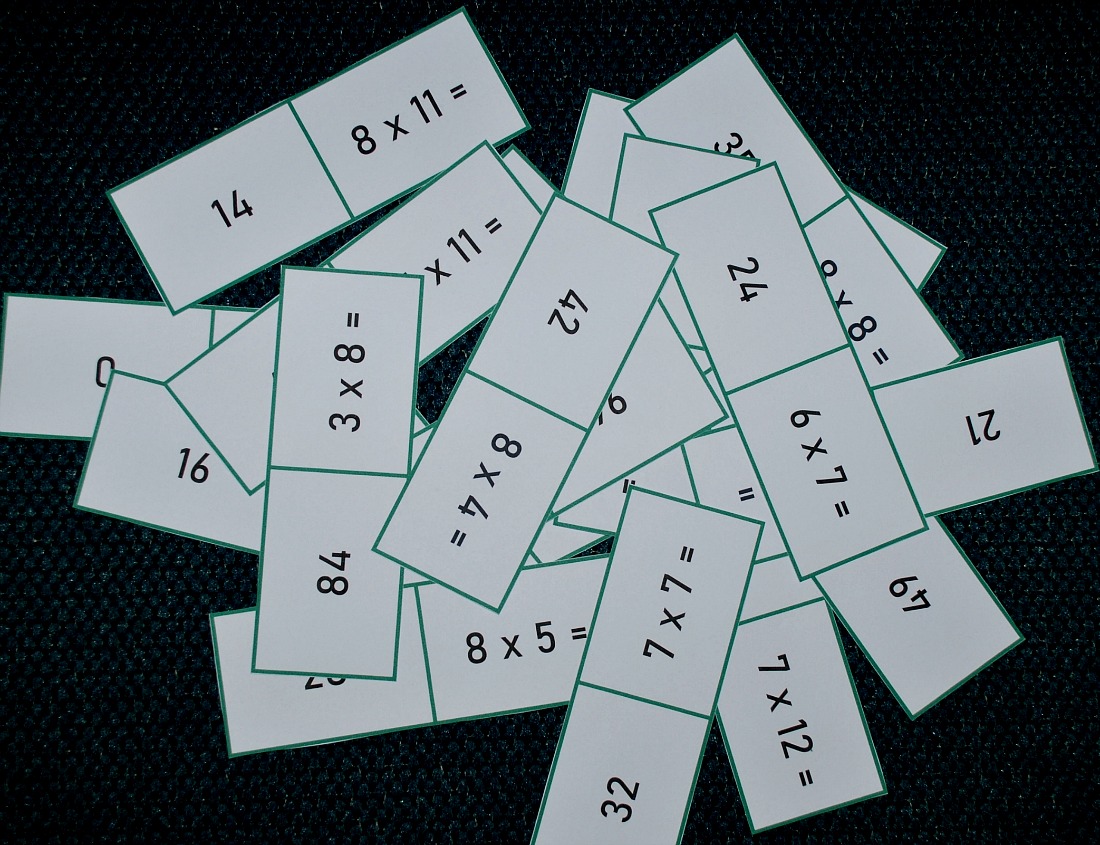
One of the ways we practice times tables is with dominoes. Really easy but the kids always prefer matching the dominoes to completing worksheets. So because my youngest has just learnt the 7 times table I thought it was time I created some new dominoes for him to practice with.

times table dominoes from ofamily learning together

times table dominoes from ofamily learning together

Each domino set is over 5 pages and has 4 dominoes on each page so it total there are 20 to practice with.

I combined two different times tables in each set.

The first one is the 6 and 7 times tables

This slideshow requires JavaScript.

And the second set is the 7 and 8 times tables.

This slideshow requires JavaScript.

I purposely changed the colours on the different sets so it would be easier to keep the cards separate (we tend to print both out and then alternate between different sets for practice).

Here are the downloads

7 and 8 times table dominoes

7 and 6 times table dominoes v2

The order that we have learnt our times tables was – 10, 2, 5, 3, 4, 8, 6 and now 7. Next we will do 9 and then 12 (my son has already figured out the 11 times table by himself). The reason why we did the 8 times table directly after the 4 was because we did it as doubling the 4 times table. So 2 x 4 is 8 which means 2 x 8 is going to be double that which is 16. He likes finding this type of patterns so whenever possible we try and highlight them.

Other Maths dominoes that I have created for the kids and that are Free to download from the blog are as follows –

Measurement Dominoes

Fraction of a Number Dominoes

3, 4, 6 and 8 times table dominoes

If you are currently working on times tables I have discovered that the Teachit Primary website creates a Free to download booklet for each times table (you do need to set up a free account in order to download their booklets – I have a few photos of what is included in the booklet here – Free times table booklet)

As always I have attaching the documents here for anyone to use. But please they were created by me for my kids so they are not available for others to upload directly onto their own site. You can link back to this page.

Posted in Homeschooling | Tagged , , , , , , | Leave a comment

Comparing Collins and Oxford Key Stage 3 History Books

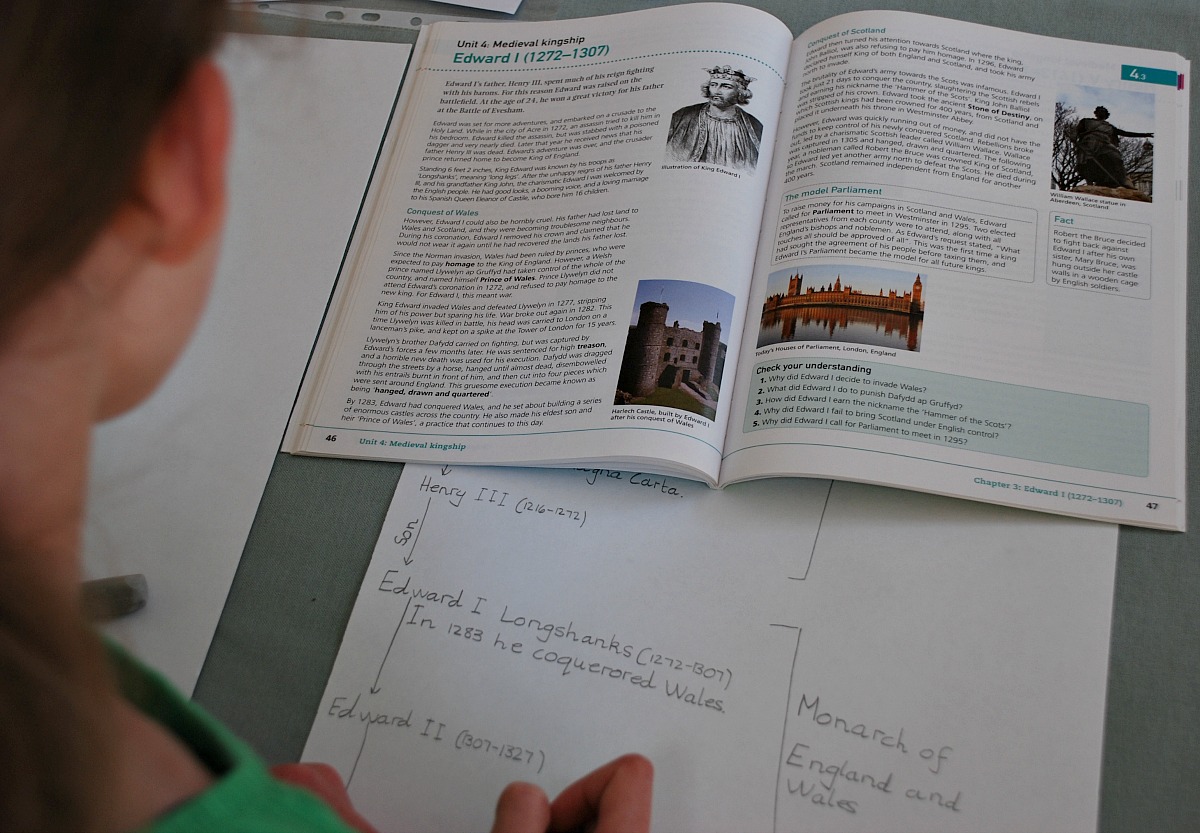
Early this year I wrote about the Collins History Books that my daughter choose while at a local book store. She selected them, so we decided to start using them for her Year 7 History but I kept feeling like I needed to add extra resources to go along with the History Book. So about a month ago when I was chatting to a PR person from Oxford University Press and I enquired about their History Book (Invasion, Plague and Murder by Aaron Wilkes). After our chat, Oxford University Press kindly included a copy of their student book in a box of secondary resources that they sent me and we have been using it and I must admit really enjoying it. Which means we now have both the Collins and Oxford History Books and have used both of them. So I thought it would be helpful to try and compare the two to give other potential users a better understanding of how they differ. I am going to give OUR opinion and then you the reader can decide.

Size, Cost and Time Period Covered

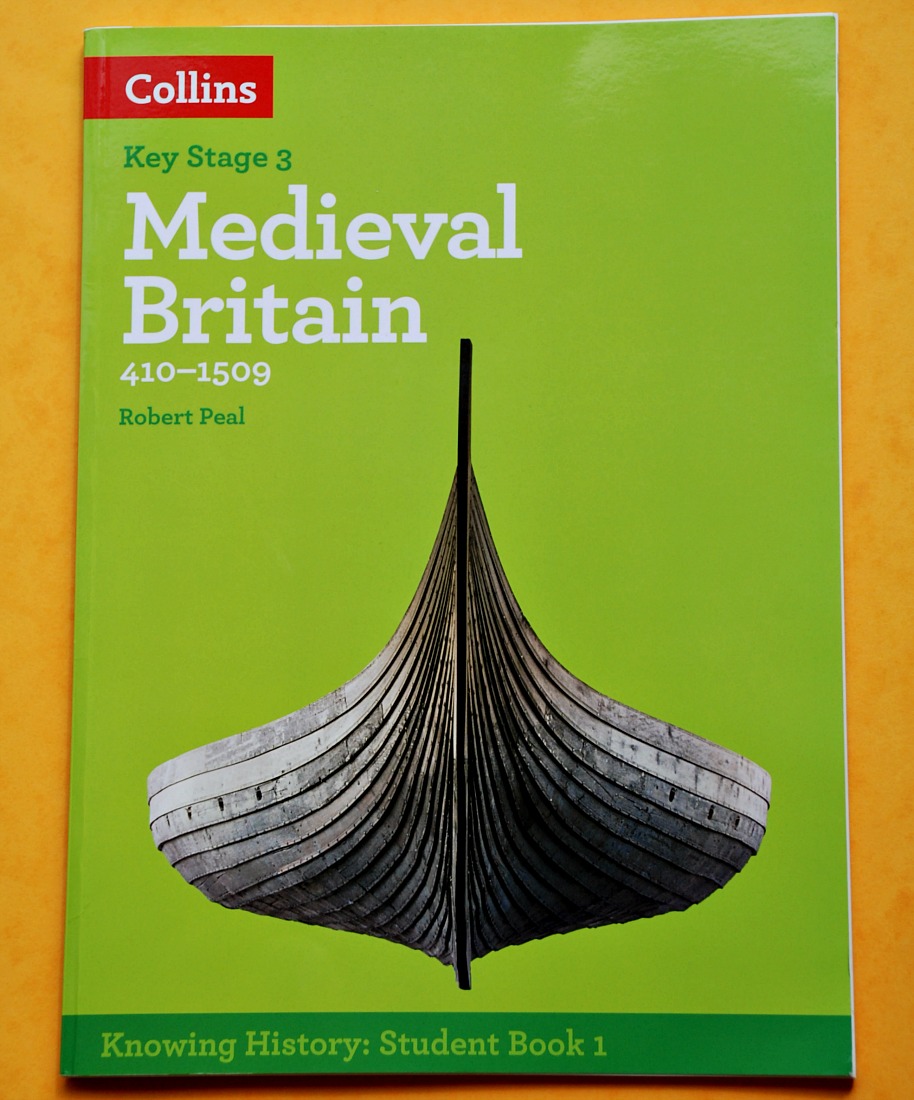
Collins – Their first Student Book (so Year 7) is called KS3 History Medieval Britain (410-1509) (Knowing History) It costs £7.99 and is 80 pages long.  It is broken down into the following chapters
  1. Anglo-Saxon England
  2. Norman England
  3. Medieval Life
  4. Medieval Kingship
  5. The Crusades
  6. Late Medieval England

Key Stage 3 History resource from Collins. Medieval Britain student book and Early Modern Britain sudent book

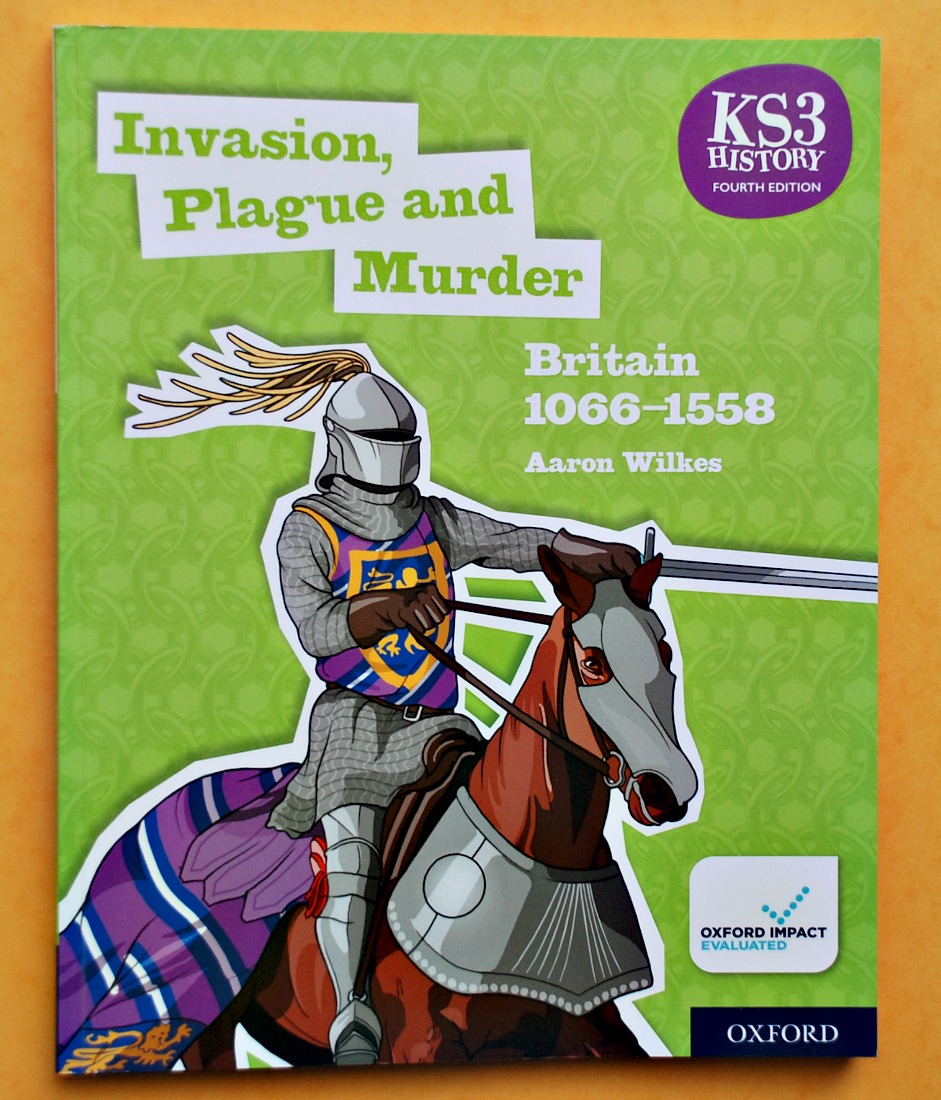
Oxford – Their First Student Book is called KS3 History 4th Edition: Invasion, Plague and Murder: Britain 1066-1558 Student Book. It costs 19.99 and is 223 pages long. It is broken down into 9 chapters
  1. 1066 and all that (this includes 8 pages on England before 1066)
  2. The Norman Conquest
  3. How religious were people in the Middle Ages?
  4. Depth Study – Life in the Middle Ages
  5. Power in the Middle Ages
  6. Health and medicine
  7. England at War (with Wales, Scotland, France and the War of the Roses)
  8. Here comes the Tudors
  9. Medieval Britain: what changed?

Key Stage 3 History. Invasion, Plague and Murder by Aaron Wilkes. A Year 7 Student Book

So straight away the Oxford one is pricier but it is quite a bit longer in terms of number of pages and has more detailed information.

Layout

Collins – Straight forward layout with short paragraphs.  Normally a topic over a double page and then 5 or so questions about the topic at the end of the page.  My daughter finds this layout very easy to read and this is why she first selected the Collins books at the book store.  She has already read through the first and second student books by herself and has asked me to buy her the third one.  So yes, easy to read, logical order, pages not crowded. I do feel like a fairly quick read as both the student books we have, so Collins student book 1 and Collins student book 2 are only 80 pages long.

(I did write a post about the Collins book here – Medieval Britain)

Using her Collins Medieval Britain book to help her create a timeline showing all the medieval rulers of England

Oxford – The pages have the appearance of being a bit more crowded, which initially was not something my daughter liked.  But after she and I read through a few pages together, she got more comfortable with the layout and started to enjoy the extra detail. 

This slideshow requires JavaScript.

She feels like they include more references to sources, which she likes because “History is about your different sources and understanding the context of the sources and then interpreting what they mean” – her thoughts.  She also really liked the labelled diagrams and the comic-strip type sections – where they depict events as they might have unfolded (My eight-year old who is not as keen on History as his older sister has commented about how these comic-strips help to bring it to life for him).  She does like the extra detail they have included but she does tend to work though this book with me as she likes to discuss it whereas the Collins book she tends to just read.

This slideshow requires JavaScript.

My personal point of view is the Oxford one has a lot more detail and the layout seems to prompt more discussions, which I like.  So possibly if you wanted a more hands-off approach then Collins but if you want more detail and are happy to do more discussions with the kids then Oxford.

Questions / Activities

Collins – at the end of each double page they have 5 questions.  There are no answers in the book but the questions are based on the text that the kids have read so I have never struggled with figuring out answers.

Oxford – They have different types of questions through the book (I like this mix of questions). At the end of each of their double pages they have an “Over to You” Section – which tends to be about 3/4 questions on the text that the kids have just read (again no answers in the student book but their Assessment, planning Guide does have answers in – I don’t have this but I have seen an example of what is included in it).  Some pages also have a Cause and Consequence section where the kids are asked to think about something a bit more.  And sometimes they have Source Analysis Questions or Change and Continuity Questions.  I like this, really like this.  I like that they have the standard questions after the text and then sometimes add in other questions directly related to concepts like analysing the sources or thinking about what was the cause of the event.

At the end of each chapter they also have an extra four or six pages of questions – this is broken down into one page of multiple choice questions, one page that is called Literacy Focus (I LIKE THIS) and then History Skills.  We are still working through the different Literacy Focus pages but they tend to be things like note taking, writing in detail, using linking words.  Really useful activities for the kids to practice and yes it is “English language type activities” but you need these skills in History.

Then History Skills – This is exactly what I felt like we needed in the beginning of this year and I kept trying to find these type of activities to add to the Collins Book.  The History Skills pages are a step-by-step guide explaining how the kids do certain things and then an exercise getting them to practice.  So after the Battle of Hastings chapter they spoke about how to write a narrative account – breaking it down into planning stages and then finally writing it.  We read the pages, did the examples and since then my daughter has tried her hand at writing narrative accounts of other events using their step-by-step guide.  Other History Skill pages include things like Interpretation Analysis, Similarities and differences and Causes.

History Skill Write a Narrative Account. Included in the Aaron Wilkes History Secondary books

These pages are what makes the Oxford book stand out for me.  Yes it covers the facts and it does that well but it builds on that.  It takes the facts and encourages the kids to think about it like a Historian, to analysis the sources, to write informative pieces about what they have learnt. It helps the kids practice those skills, practice analysing sources, practice writing down the facts in a well-constructed manner. As a home educator this is that extra bit that I was searching for.

This slideshow requires JavaScript.

Conclusion

We are using both books. My daughter likes reading the Collins books independently and we like working through the Oxford one together and I feel like it is helping her to build skills.  I know most people will only use 1 book so I suppose it depends what you want – do you want a nice quick easy to read summary of events – then Collins.  Do you want a more detailed book that is going to actively help the kids work on history skills while learning about the facts – then Oxford.

This is just my personal view of the two books.  I have written this post hoping that it will help others who need to decide which History Book will suit them.


Posted in Homeschooling | Tagged , , , , , , | 5 Comments

A week’s break

I never really like answering the typical “so the schools are on holiday/ break next week are you also on holiday?”  Normally I just say “No we don’t follow school schedules” and leave it as that, because I often don’t feel like getting into a long discussion about how we take breaks and what having a break means for us. (And no I am NOT being horrible it is just sometimes it is easier to give a quick answer and move on then try and stand in the middle of the shop explaining how it works.)

For me there is a difference between “school activities” and “learning”.  So yes sometimes we have a break from school type activities but in all honesty we don’t have a break from learning.  For me, typical school activities would normally be workbooks, working through written Maths (and I inserted written as I am not including the Maths you do in everyday life), completing English Grammar exercises – those type of activities fall under my umbrella of the typical school activities that we do.

But then there is Learning.  Learning for me, is far broader and a lot of the learning that happens is driven by the kids. Learning includes reading, watching programs, going to an exhibition, trying something yourself and even sometimes failing (last week my daughter tried a new recipe that was a complete failure but she tried something new and afterwards she figured out why it failed). Learning takes on lots of different forms for different kids.  Sometimes it is very topic specific.  So in our house my son is always learning about animals and dinosaurs, independently and my daughter is always learning about History.  They drive that, they create their own projects relating to that and I often don’t get involved unless they come to check some spelling, format, or need me to help them find something.  I have books and books that they have filled with their projects – yes there are errors and No I don’t go through and correct the errors – I want them to keep enjoying their projects and me going and correcting every little thing is not going to encourage that.  So learning happens regardless of me declaring we are having a break for a week.  That is NOT going to stop either kid from doing more research on one of their topics.

I have said before we don’t follow school schedules so why are we having a slow week next week – it is just a total coincidence that our week’s break is the same as the local half term.  Normally I try and avoid that timing because half term or holidays means everywhere is crammed and busy so really not the best time to go out exploring when we could go at a quieter time.  But next week we are having a slow week because I am tired, mentally tired.  I am tired because home education is a big responsibility and I take it seriously.  I spend a lot of time thinking about what we are doing, how we are doing, if we need to change anything, I spend ages researching and reading up topics so I can assist the kids.  Home education is not sometime I take lightly I put everything into it.  So yes at times I feel exhausted, like I need to just take a breath and read a book for myself or paint a picture just because.  And NO me admitting that I need a break every once in a while is NOT me saying that is NOT working.  Because it is working.  I still know this is the right journey for my kids, in fact I am even more convinced than ever that this is an amazing opportunity for the kids.  I think home educated kids are given a gift and I will work my butt off making sure mine get the most out of this experience. 

For me a slow week / a week’s break means no typical school activities – no written Maths, no written English grammar or workbooks.  We will read (kids to themselves, me to myself and us altogether), we will work on art projects (I assume this will happen because I want to do a painting and if I start painting the kids always end up joining me), we will bake, we will watch some new documentaries (my daughter has two History ones that she wants to get into), my son will work on his latest animal book (he has created 19 new animals all of which need diagrams and fact pages written about them – his own project) and we will see some friends. 

So yes we are having a break next week but No the learning will not stop.

Winter walk. ofamily learning together

Posted in Homeschooling | Tagged , , , | 1 Comment

Silhouette Paintings for Fun

We have been doing a lot more “focused” art lately – working on drawing skills and projects linked to the kids art awards, which has been really good but at the same time I kind of feel like some of the fun has been missing. So the kids and I decided to do a painting project just for fun, nothing that ties into any project but just something they liked. They choose animal silhouettes (dinosaurs would also work really well with this).

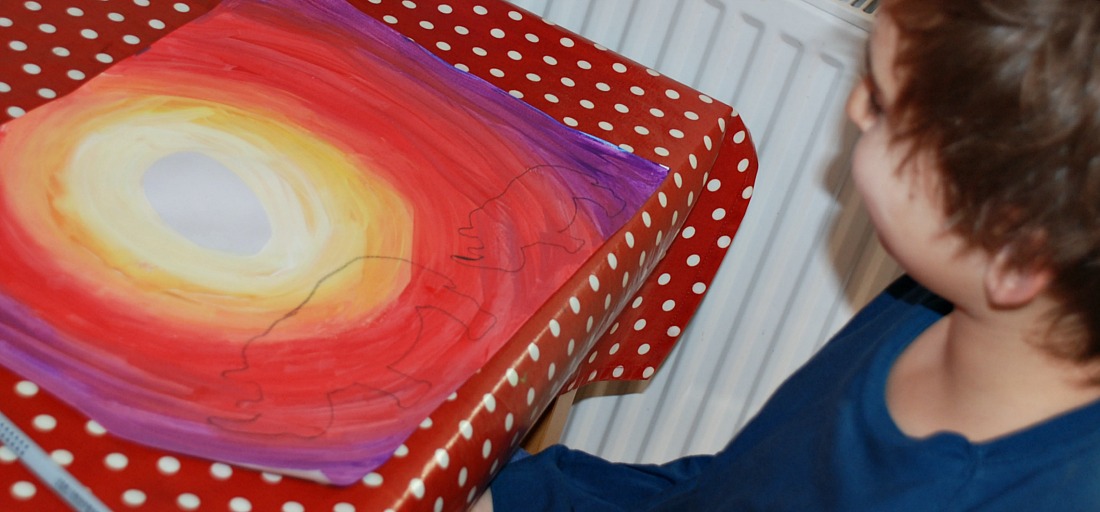
We started by creating our backgrounds. We did two versions – one circular – starting with a white centre and then getting darker and one more like a flash with lines going out – again starting with a white centre and then getting darker.

This slideshow requires JavaScript.

We left our backgrounds to dry overnight and then the kids started drawing in their animals. We kept the animals very stylized as our idea was – dark animal silhouettes against a colourful background.

adding rhino drawings

And then we painted the animals. The first two were both shark paintings. My daughter actually created a simple shark template which they cut out and then traced around to get a consistent shape.

This slideshow requires JavaScript.

But then we got some variety.

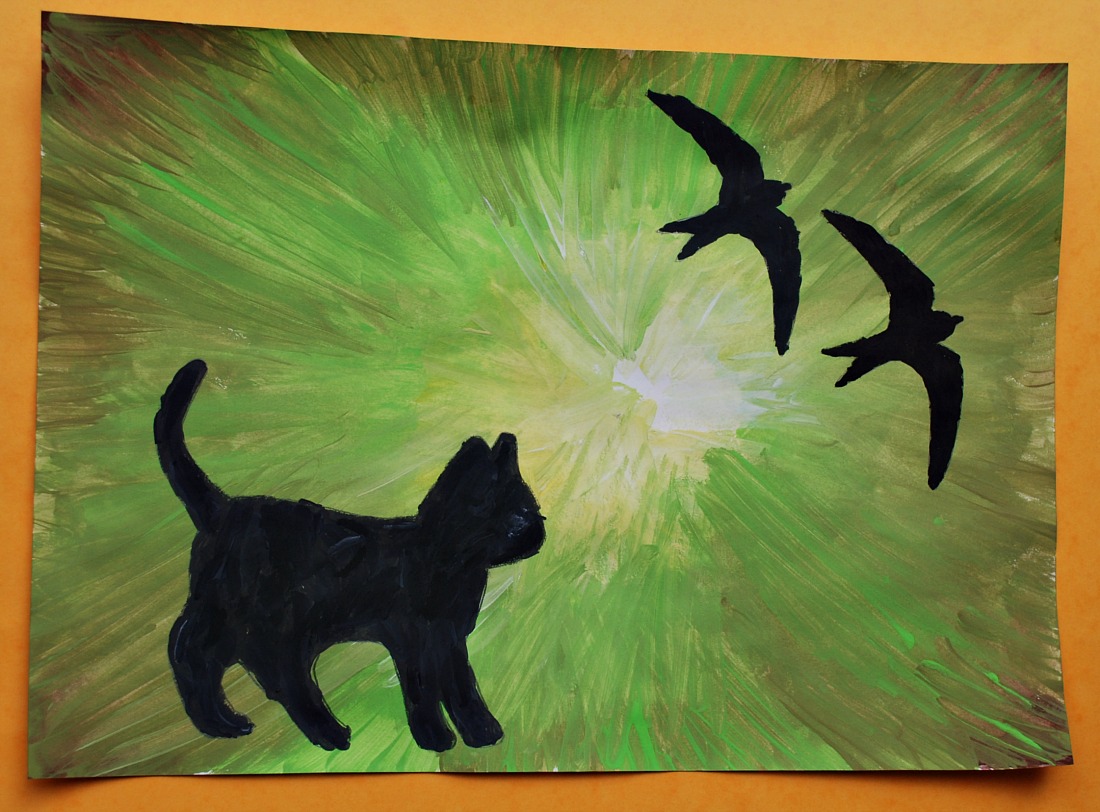
A cat with swallows

Animal silhouette paintings.  A cat with 2 swallows

The Rhinos.

Rhino under the African sun.  A silhouette painting created by kids

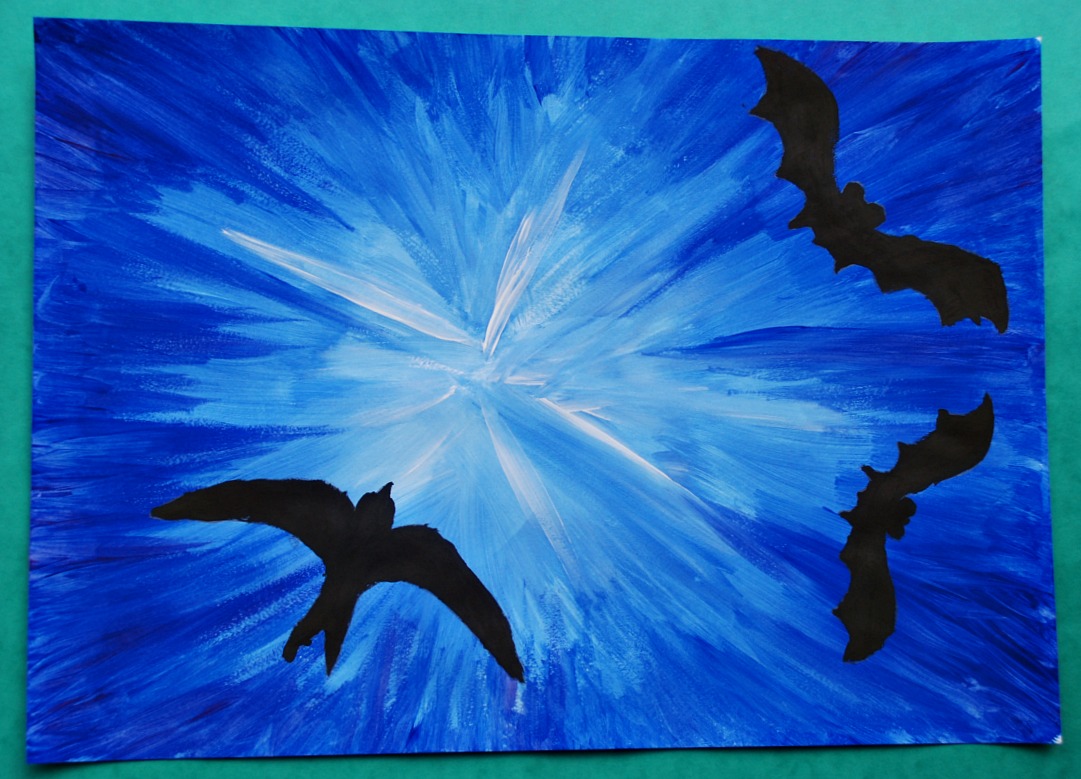
And bats and swallows (apparently the bats are flying away and the swallows are arriving)

Animal silhouette painting by kids

We did the paintings over 2 days, but it was 2 relaxed days of art and chatting, just the way I like our art sessions to be.  And even though we kept our drawings very simple I think the dark silhouette works really well. If your kids are not happy to draw their own animals you could look for some simple templates (Activity Village have a bunch).  Or even Stick puppet outlines would work because you only need the basic shape.

I really like the end results but even if the end paintings had been a total mess it was just some fun art, playing with brush strokes and colours.

Posted in Homeschooling | Tagged , , , , , | 1 Comment