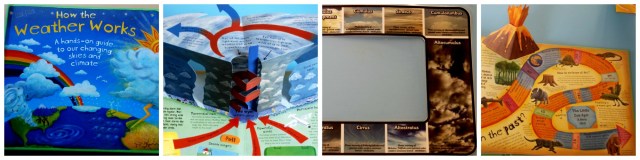
Core Knowledge Year 4 Book

I have used the Core knowledge books for a number of years (original Core Knowledge book post).  Over the summer I finally got a copy of the year 4 book – so this is what I think about the Year 4 book.

what-your-year-4-child-needs-to-knowThe year 4 book is broken down into the same topics as the previous years and is written in the same style.  It is not a detailed curriculum with daily lesson plans.  It is a general outline of ideas and activities which you can include in your learning.  It does build on some of the learning which was covered in the earlier books of the series.

As with the previous Core Knowledge books I love the resources list at the end of each topic.  Lots of brilliant suggestions and I have already bought a few and I have a bunch sitting on my Amazon Wish List.

The book is broken down into the following categories.

1. Language and Literature

This includes examples of poetry and stories to read with the kids (and no it does not include comprehension type questions after each story or poem).  It also includes Legends and Myths from Ancient Greece and Rome.

The language part includes bits about how you set out a letter, sentence structure and parts of speech.  I find it useful to read these bits before I do a project with the kids as it helps to refresh my existing knowledge

2. History and Geography

This section is broken down into Mediterranean Europe, Eastern Europe and British geography.  The geography sections does assume that the kids already have a bit of basic geography knowledge like what the continents are.  The historical part deals with Ancient Rome in quite a bit of detail (we are hoping to use this soon) and British History.

3. Visual Arts

I really enjoyed skimming through this chapter.  Lots of great ideas and activities which I am dying to try.

4. Music

This chapter deals with the elements of music, different parts of an orchestra and composers.  It also gives some ideas for songs which the kids can use.  I especially like the fact that they give suggested audio recording at the end of this chapter as I really want to get some new music for us to listen to while we are at home or out driving somewhere in the car.
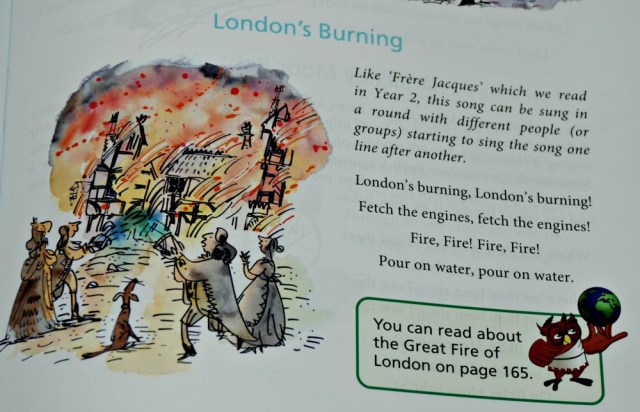
core-knowledge-book-4-music-chapter

5. Mathematics

I love this chapter.  As with all the other maths chapters in the earlier books it breaks maths down into manageable bits.  It explains the concepts in simple terms and gives ideas on how to teach the kids the maths concepts in ways that are straightforward.  No it is not as detailed as if you bought an entire maths syllabus but I really enjoy reading the maths chapter and in past years I have referred to the maths section on numerous occasions.
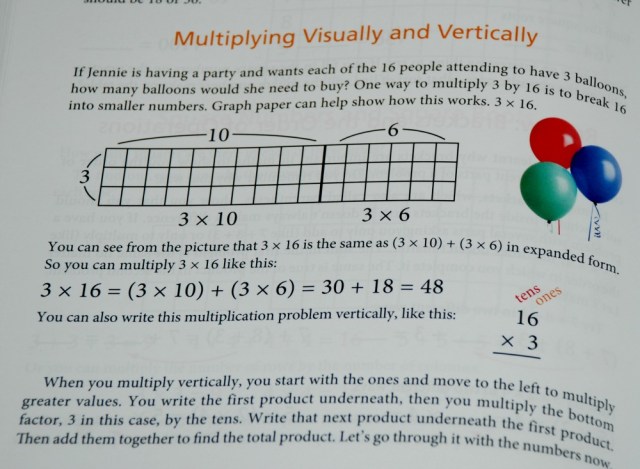
core-knowledge-year-4-example-of-maths-included-in-the-what-your-child-should-know-series

It covers place value up to 100 thousands, rounding numbers, ordinal numbers, addition and subtraction, more than one operation in a sum, multiplication and divisions (short and long ways of doing both), roman numerals, fractions, decimals, time, graphs, geometry, weight and measurement.   I know I am going to find this chapter very useful.
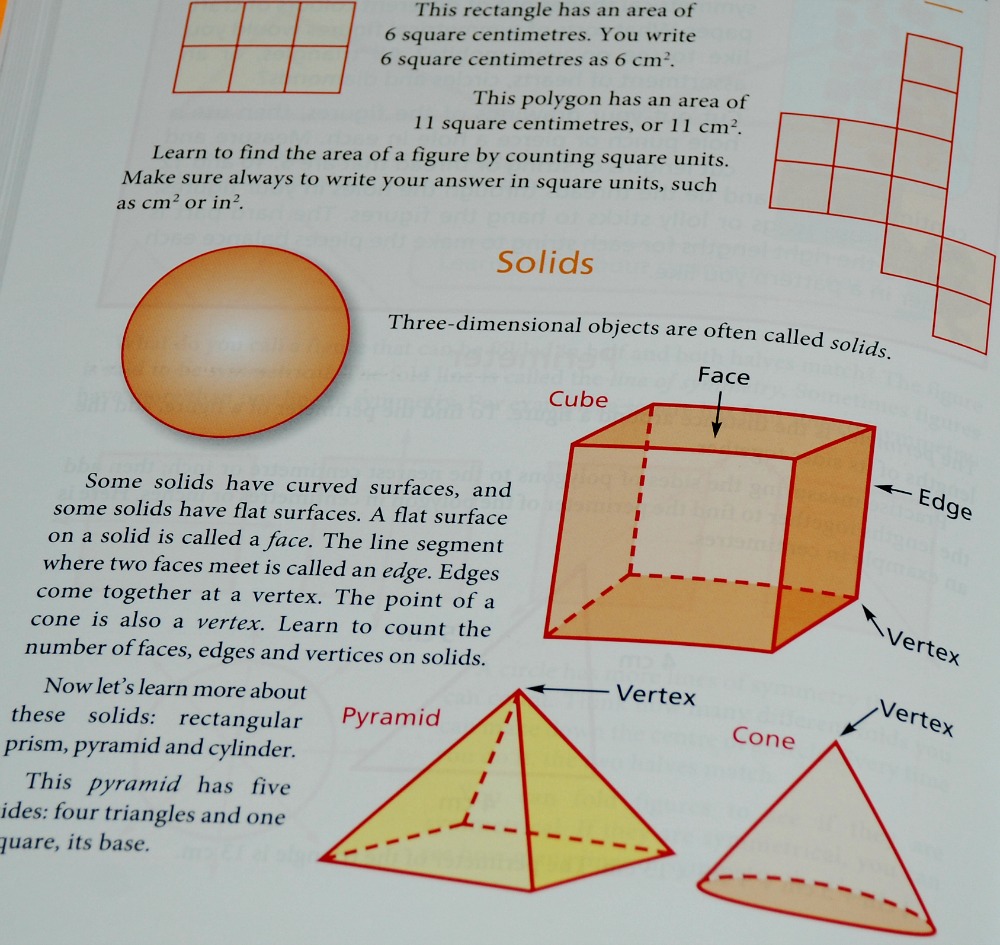
what-your-year-4-child-should-know-a-page-out-of-the-maths-section

6. Science

I love that at the beginning of this chapter they recommend taking your kids to a Science museum and name a few in the UK (brilliant way to start a chapter on science encouraging you to get out and experience it with the kids).

The chapter cover classifying animals, ecology, the human skeleton and muscular system, the human brain and nervous system, light and vision, sound and hearing, astronomy and the lives of famous scientists.

In previous years I have used the Science chapters in the earlier books a lot and I have a feeling that this year a lot of our inspiration and starting points might also come from the Science chapter.

what-younr-year-4-needs-to-know-science

I have used the earlier Core Knowledge books over the past three years and I am definitely going to be using this year 4 book with my daughter.  As in prior years I do not expect the book to be the only resource that I use.  I will use it as a guide, a suggestion of what to cover with my daughter and how to help her grasp certain topics.  Her way of learning is not the same as mine so I find it very useful to read books which give suggestions on how to explain and tackle concepts.

I plan on doing an updated review of the year 4 book at the end of my daughter’s year 4 academic year and I will include more detail about what we used and liked.

You can buy the Core Knowledge books in Amazon – here is a link for the What Your Year 4 Child Needs to Know: Fundamentals of a Good Year 4 Education

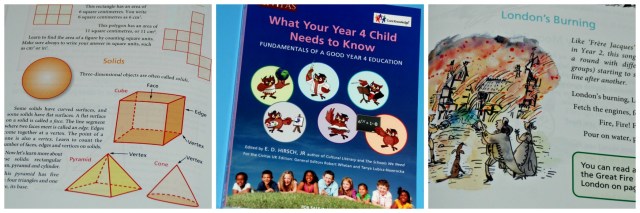
core-knowledge-book-year-4


Save

Save

Save

Save

Save

Save

Posted in Home education resources | Tagged , , , , , , | 3 Comments

Easy Template Art Activity

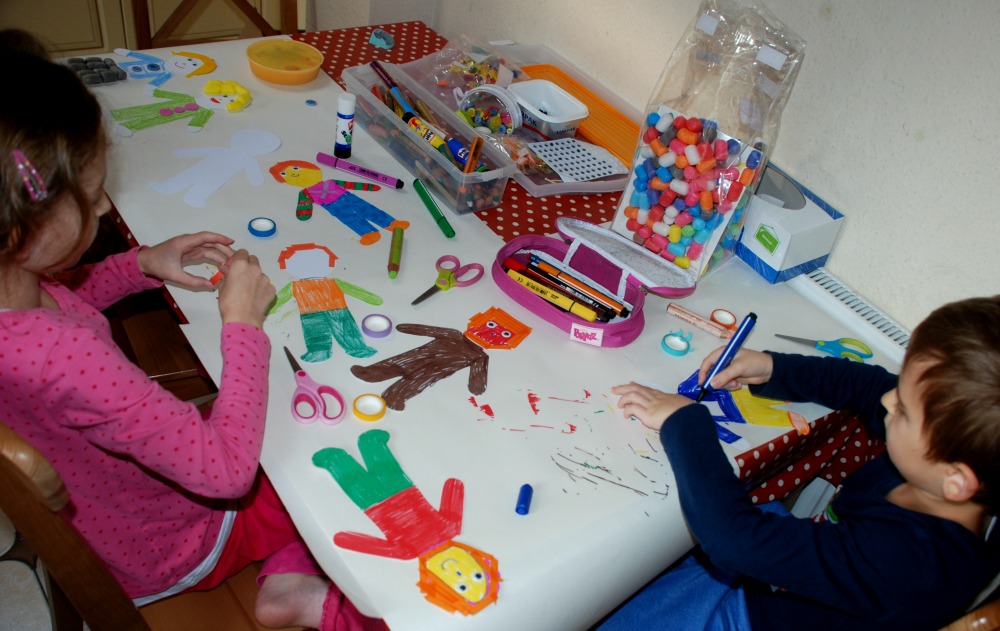
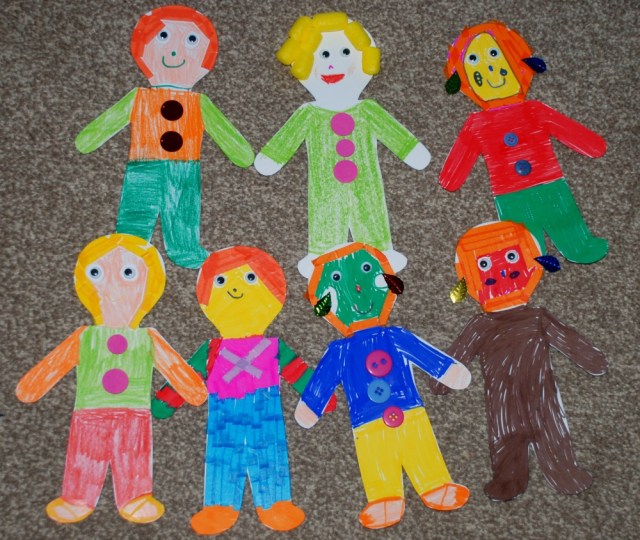
This week has been tough (and yes it is only Wednesday) our boiler decided it was going to stop working (in case you are not from the UK the boiler is what controls your hot water and heating).  So in an attempt to distract the kids, I set out an art activity that I have been meaning to do with them for ages.  I used the Free to download Person Template from Activity Village, cut out a number of little people in card and then collected some goodies from the art cupboard and suggested we make some people.  (Update – when I wrote this post the template was Free to download it is now part of the Activity Village membership package)

Both kids immediately thought this was a good idea and jumped right in.

crafting at our kitchen table


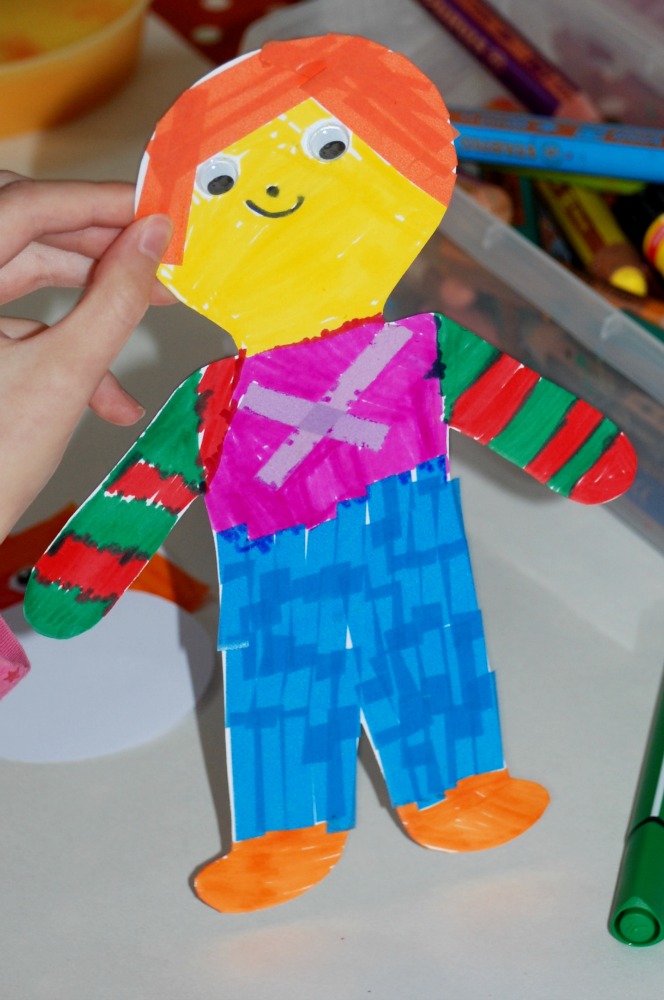
I thought they would do collage people – lots of sticking of crafty bits – but both kids surprised me and choose to colour most of the template in and then just add bits for detail.

body-template-free-to-download-from-activity-village

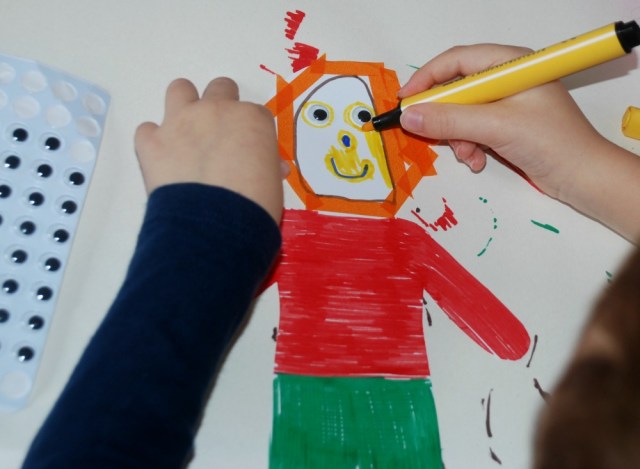
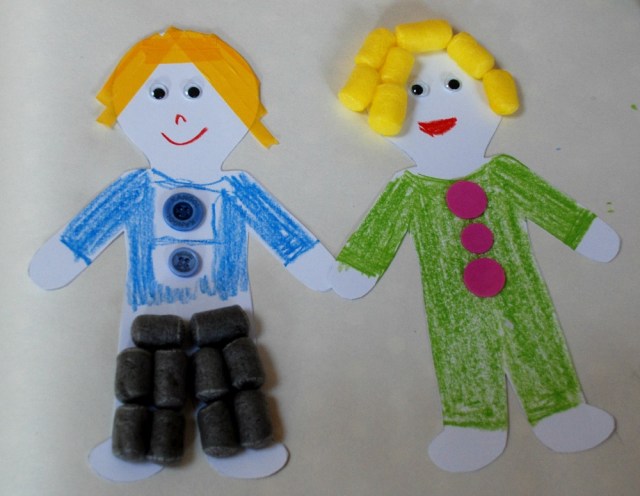
They both seemed to like using the coloured tape for hair, googly eyes were a must on all the people and a few were even given earings.

The Magic maize was also used on two people – one person was given magic maize hair in an attempt to make curly hair.

body-template-easy-craft-activity-for-young-kids-using-the-body-template-from-activity-village

It was a very simple activity to set up but I do recommend cutting the people out of card if the kids are going to add lots of detail.  It also was a great activity for the kids in terms of planning.  My youngest realized that sometimes it is best to do certain things in order.  He stuck some buttons on and then tried to colour his one person only to realize that it would work better if he did the colouring in first and then added the details afterwards.

Young Child's easy craft activity using a people template

I love simple art activities like this where the kids can just have fun and be creative.  My son will often start an art activity with us but rarely is still sitting at the table by the time his big sister finishes.  However with this he happily sat and made 4 different people and only stopped when he had finished using all the templates.  I am definitely going to try to use more simple cut out templates with him in future – they really do have a big selection on the Activity Village website

using-the-person-template-from-activity-village-for-kids-art

Kids art activity using the Free to download people template from Activity Village

Save

Save

Save

Save

Save

Save

Save

Save

Save

Save

Save

Save

Posted in Art and Craft Ideas | Tagged , , , , | 1 Comment

Labelling our home

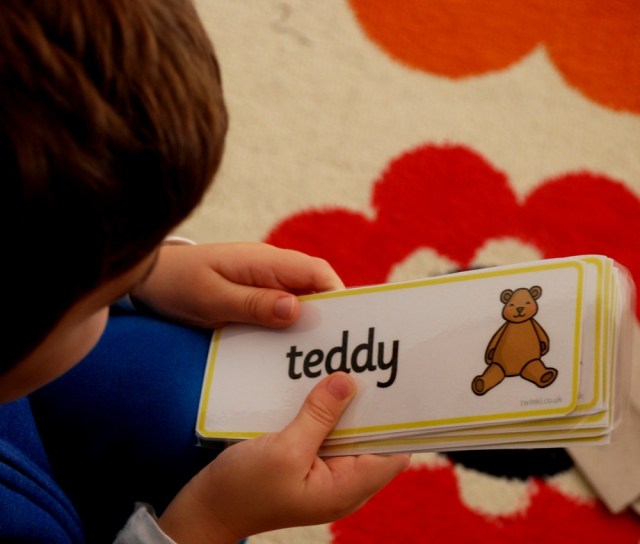
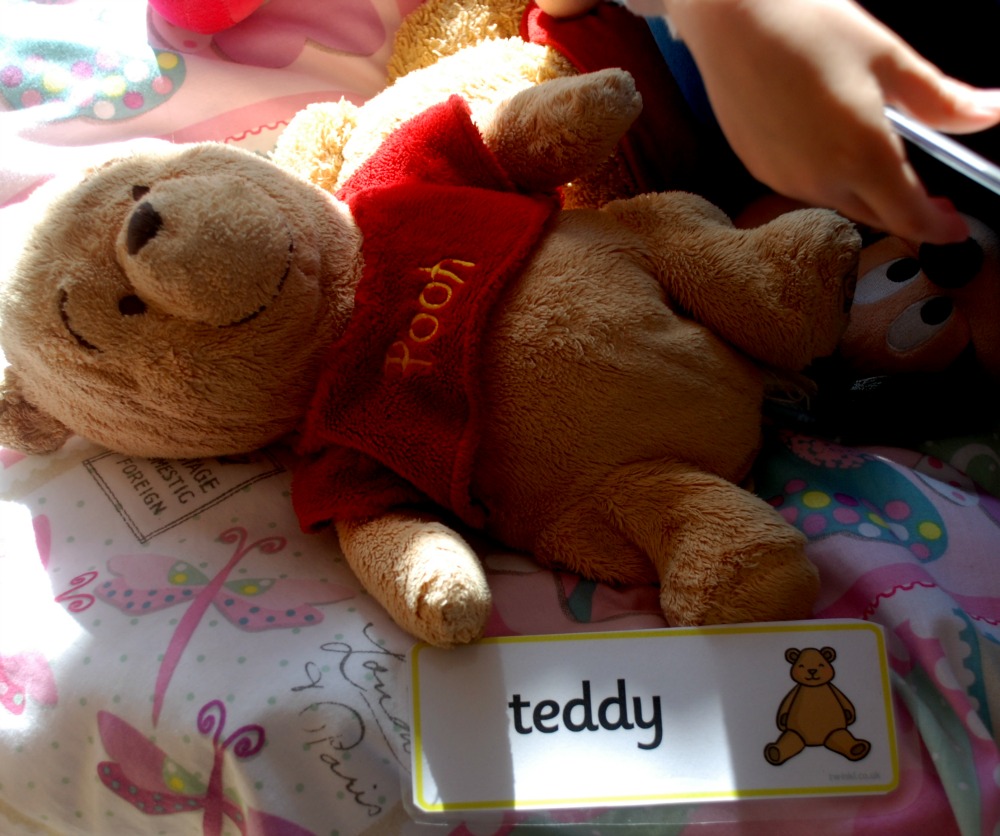
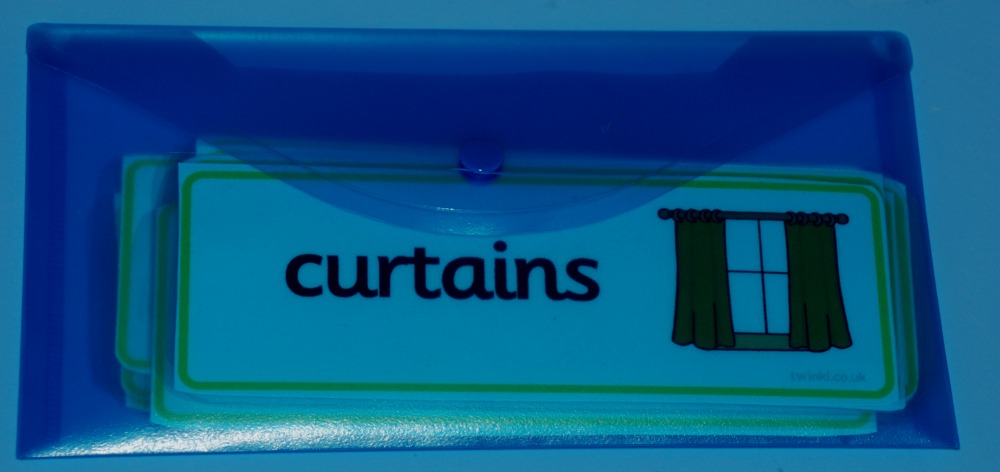
When my daughter was first learning to read we did a label the house activity (I made some simple word cards and she walked around the house labeling everything).  She thought it was a fun activity and did it a number of times so I thought I would try the same activity with my youngest.  This time I used some Free to download home word cards from Twinkl (I have no idea what happened to the cards that I made for my daughter – totally blame the fact that we had two house moves since then).

home-word-cards-lots-of-house-topic-word-cards-all-free-to-download-from-twinkl

I was a little bit nervous that my youngest would just guess the word based on the picture but he did not.  He carefully sounded out the word and tried to figure it out himself.

label-the-house-with-word-cards-teddy-free-to-download-from-twinkl

label-the-house-cards-teddy

My son enjoyed the fact that it was a reading activity that involved him walking around the house and placing cards on the correct objects.  He does tend to enjoy moving while he learns so this suited him.

And some of the words were a lot longer and more complex than what he would normally read but he still tried them.

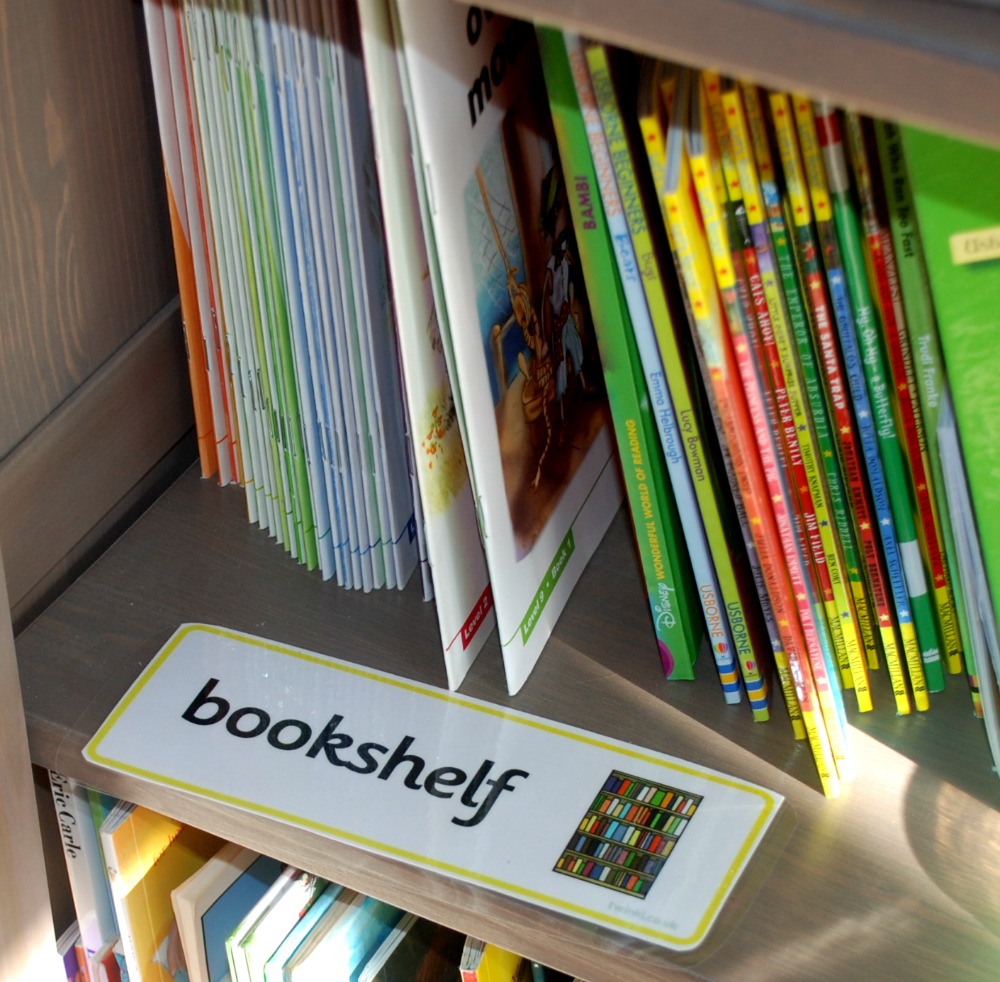
home-word-cards-bookshelf-word-card-from-twinklThe download includes a lot of words. We did not use all the words and I found it better to split the pack of words up so that he was not doing too many in one go.

After he had finished his labelling he got to keep his word cards (we packed them into a small plastic folder) and he left them on his table.

word-cards-in-plastic-folders

He is just starting to write out random lists but I have found that he gets frustrated when he can not spell lots of words and gives up.  So we have left his home cards for him to use.  (The list making is something that his sister does on a regular basis and he likes to sometimes join in – it normally involves writing a list to go with a game they have made up).

home-word-cards-free-to-download-from-the-twinkl-website

label-our-home-word-recognition-activity-for-young-children-free-to-download-cards-from-twinkl

Save

Save

Save

Posted in Homeschooling | Tagged , , , , , , | 2 Comments

IKEA goodies we use in our home-educating life

There is no denying our decision to home-educate the kids has meant I have become a lot more cost conscious.  We have gone from a two income family to a one income family where all the kids educational supplies and activities have to be bought and paid for by us (I am not complaining we choose to do this as we believe it is the best situation for our kids).  But the fact remains we have had to tighten our belts and I have had to become a lot more aware of prices and the fact that sometimes cheaper can mean more expensive (when you have to replace the item after only a few uses).

Quite a few of our home-education goodies (over a 4 year period) that we use time and time again have come from IKEA so I thought I would put together a little list of the IKEA items that we have bought, used and loved (this is a totally personal list – I have not been asked to do this).

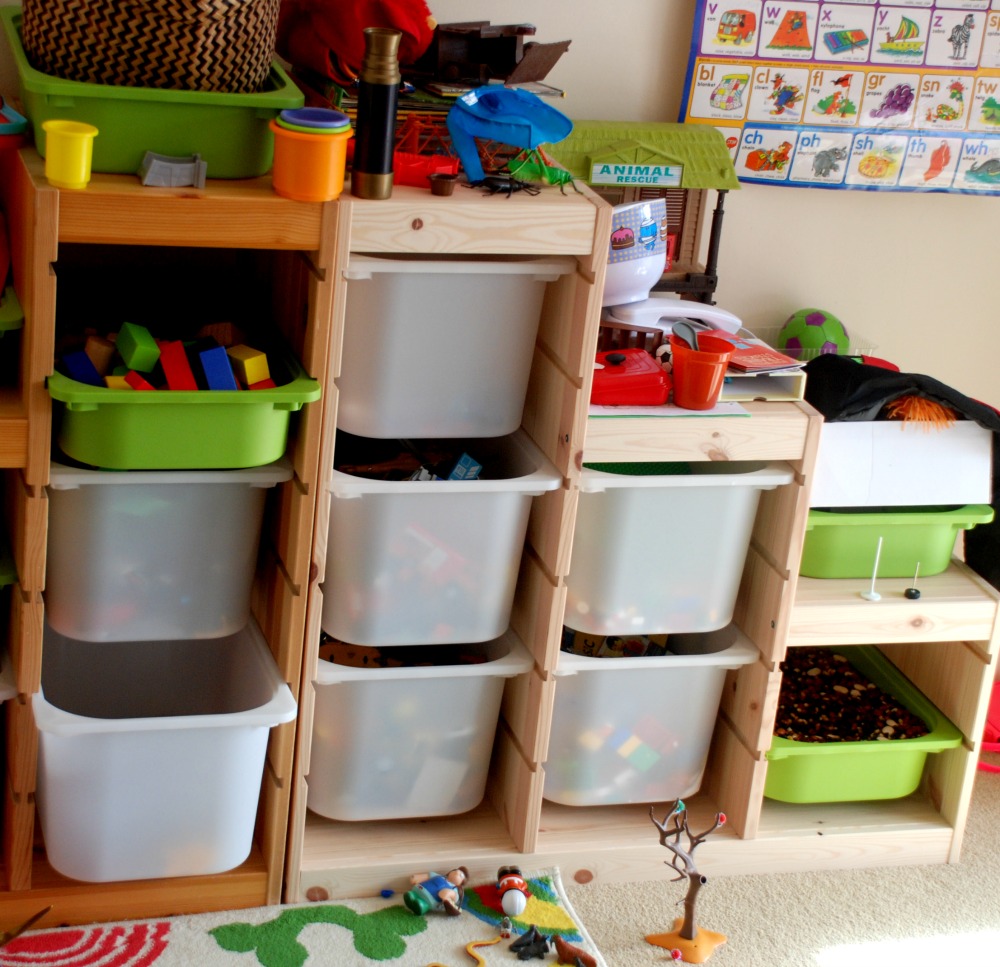
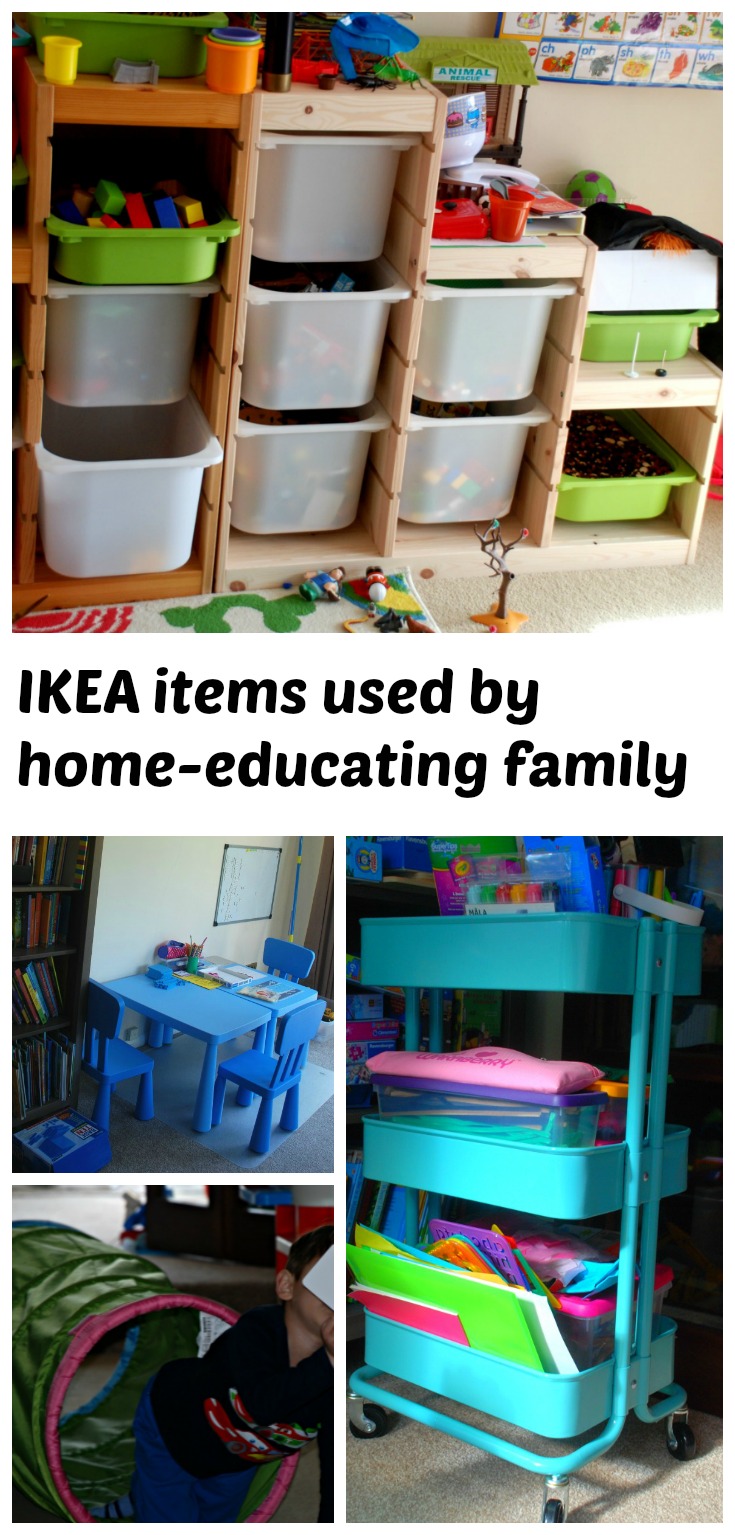
Our kids TROFAST storage units.  We first bought one of these 4 years ago and have since bought a number of additional units.  One of the things I like about this product is you can arrange and rearrange the drawers to suit the kids toys.  My kids are constantly pulling out drawers and repacking them and we have never had a stability issue.  And once the kids become a bit older IKEA sell shelves that you can add to the unit and it can become a bookcase instead of a toy storage unit.

trofast-storage-unit-used-for-the-kids-toys-and-games

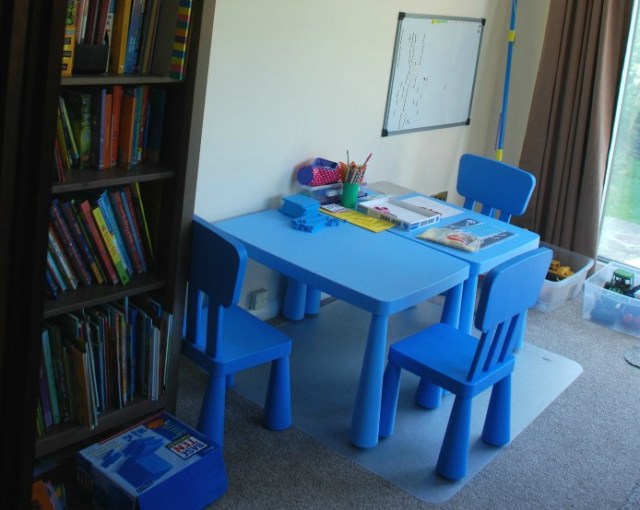
The kids plastic tables and chairs (Mammut) – love love these.  We have used our so much over the past 4 years, they have been used for drawing, painting, all kinds of crafting, used in toy shops, as a vets table, for card games and other games.  And they have lasted so well.  They are incredibly easy to clean.  I am actually feeling a bit sad that my oldest is now getting too big for the table as I honestly do not know what I am going to get to replace them.

home-ed-area-kids-play-area-with-bookcase-and-table-and-chairs-for-them-to-use

Our floor protector (look in the photo above it is the plastic mat under the blue tables).  My husband actually bought this for his home office but when I saw it I quickly stole it for under the kids table.  It is brilliant for protecting the carpet from play dough and crafting spills.

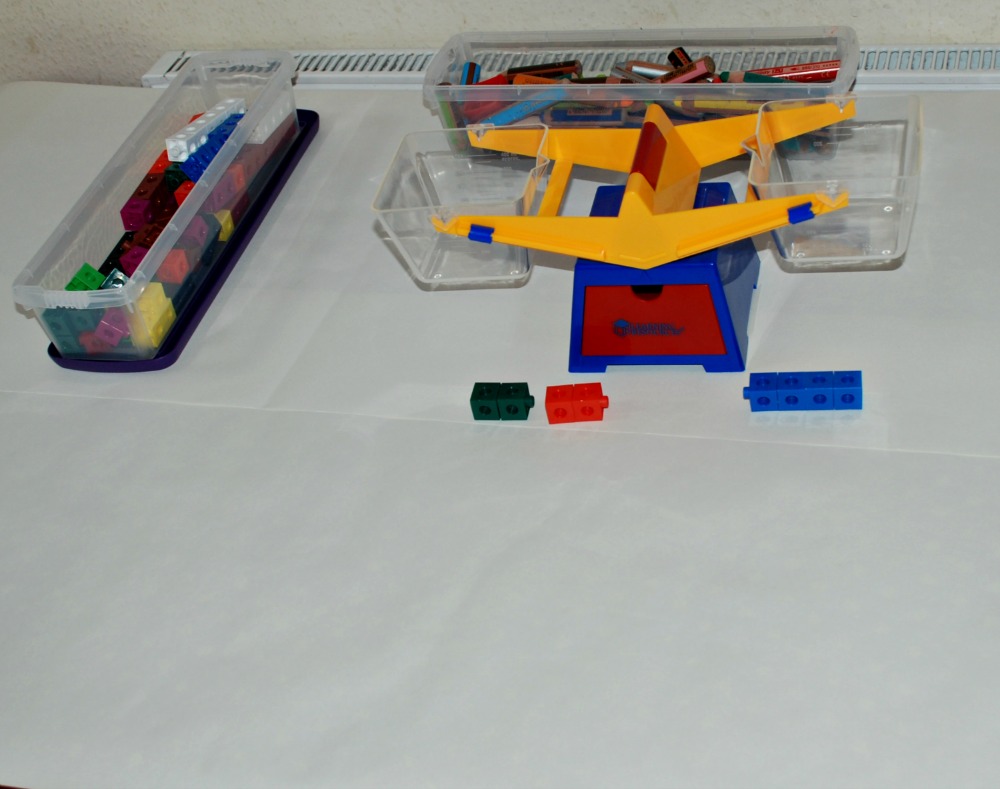
Roll of drawing paper.  One of my personal must have items for our house.  Every time we go to IKEA (or when a friend goes and offers to pick up something) I always get one roll.   It is very easy to just unroll the paper and leave it on the kitchen table for the kids to do whatever they want on to (paint, draw, use oil pastels).  But this roll of paper has also become part of my daughter’s maths learning.  I discovered about a year ago that if I covered the kitchen table with paper, added a few maths resources and pencils and left my daughter to do her maths for whatever reason she was happier than when I handed her an A4 piece of paper.  She likes being able to scribble her sums and thinking all over the paper, it seems to be a freeing thing for her and has really helped her maths confidence.  So yes I always have a roll of this paper lying next to our kitchen table.

snap-cube-set-up-idea

We also love the Whiteboard marker pen set – we love “magic pens” as my kids call them and this set is probably my favourite set.  We have had ours for ages and we use the pens often and they are still going stong.

If you read my blog on a regular basis you will know that my daughter enjoys doing arty projects with me but one thing you may not realise is she is particular about the arty items that she uses (part of her SPD).  If we are attempting to do an art project and the materials that we are using have a strange feeling or a strong smell she will quickly get overwhelmed and will end up stopping part way though.  So after lots of trail and error I have realised that to help her enjoy the arty projects and to be able to sit and complete them having certain items helps – eg her favourite paint brushes (I actually keep 2 spare packs of these in my cupboard at all times so she never runs out) and this paper (honestly I can not explain what it is about this paper but she loves it).

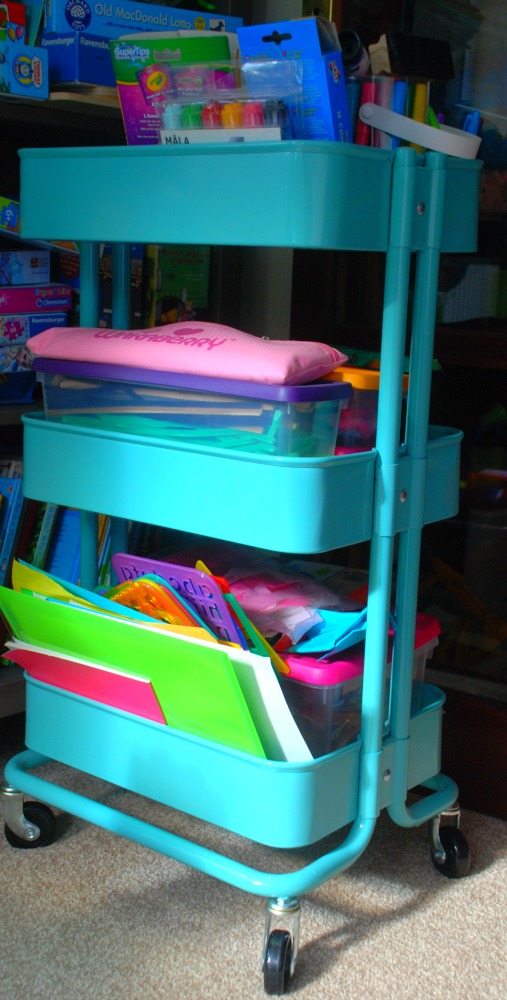
And speaking about art supplies – we still love our Art Cart. (full post about it)

ikea-art-cart

Beads and Boards.  We love Hama beads in our house but they are expensive and we do a number of projects with the beads and at one stage I even used them in sensory tubs so it was getting very expensive until I realised that the IKEA beads and boards work just as well.  We now have a large jar of IKEA beads and the kids have not noticed the difference (but my bank account sure noticed it).

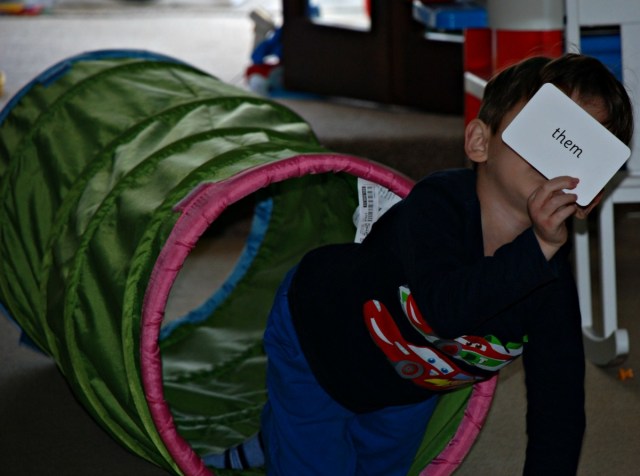
I have often mentioned that both my kids have had Occupational Therapy.  Our therapists have been amazing and I would be lost without them but I have also made a huge effort to include items in our home which can be used by us to continue some of the therapy activities at home.  The BUSA play tunnel was one such item which we bought 4 years ago and I am honestly amazed that it is still in one piece.  We have used it for many obstacle courses and games and the kids have been quite rough with it but it is still going stong. And a recent addition has been the IKEA folding gymmat.  We use it a lot when the kids are bouncing on and off the trampoline.

word search though the tunnel

I honestly could go on and on about the IKEA products that we use and love (don’t get my started on using IKEA goodies in sensory bins, I am like a child at Christmas when I walk into their marketplace).  But the last item I will include is actually one that I am hoping might appear under my Christmas tree this year.  The EKTORP Footstool.  I know two fellow home-educators who own this and it is fab.  It can be used as an extra seat, it has hidden storage inside (just lift the seat and you could store some books or board games) and it can also be used as an extra surface for the kids to unpack their games on and play.  And then of course once everyone is tucked up in bed I can use it as a footstool (Really hoping Father Christmas brings me one this year).

ikea-items-used-by-our-home-educating-family

Save

Save

Save

Save

Save

Posted in Homeschooling | Tagged , , , , , | 3 Comments

How The Weather Works

One of the topics that we are learning about at the moment is weather (it is one of those background topics that the kids ask about, we do some reading, leave it and a few weeks later we read a bit more).

I wanted to get a good book that we could use for this topic – something that would engage the kids but that had enough detail for my daughter (she would be year 4 if she was in a UK school).  I wanted a book that would slightly challenge her and get her to ask questions and think about the weather in a bit more detail.  The Core Knowledge Year 3 book suggested a book by Christiane Dorion  called How The Weather works.  And as I have been impressed with the book recommendations made in my Core Knowledge books I tried my luck and contacted the publishers and asked if they would send us a copy to use.   They kindly send us a lovely package of educational books for the kids to use.

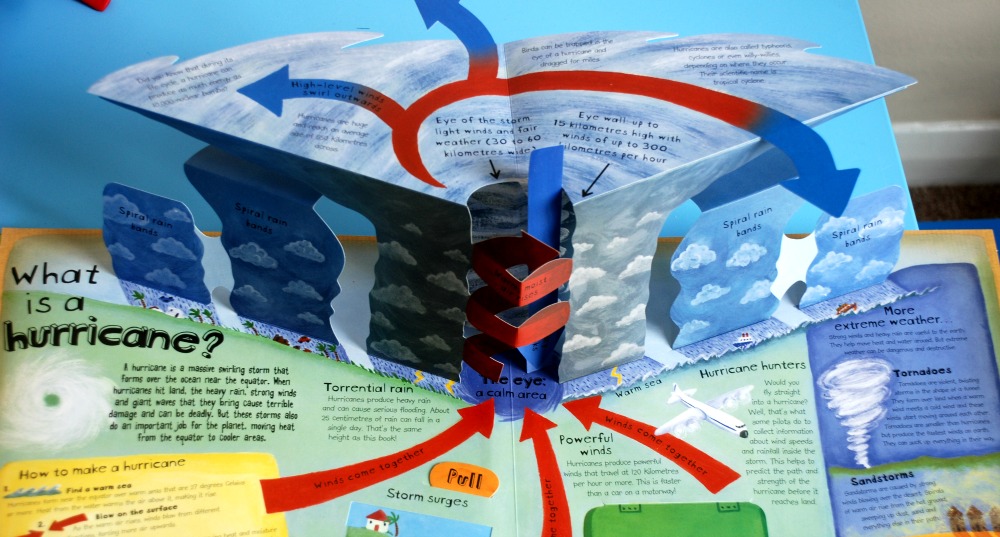
And even though I was really wanting this book for my oldest to use, my youngest is fascinated by it.  He loves all the flaps and pop up bits.  He is especially taken with the hurricane page, I keep finding him sitting on the couch staring at this page, he now thinks hurricanes are incredible.

how-the-weather-work-books-pop-up-showing-what-a-hurrican-is

The book itself is 9 double page spreads (a new topic per double page).  It covers

What causes the weather ?

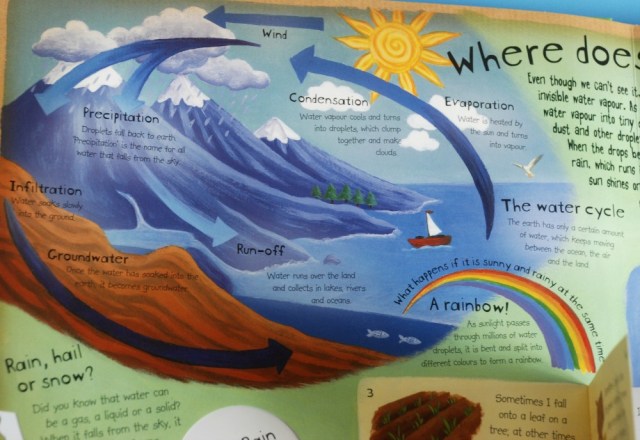
Where does the rain come from ?

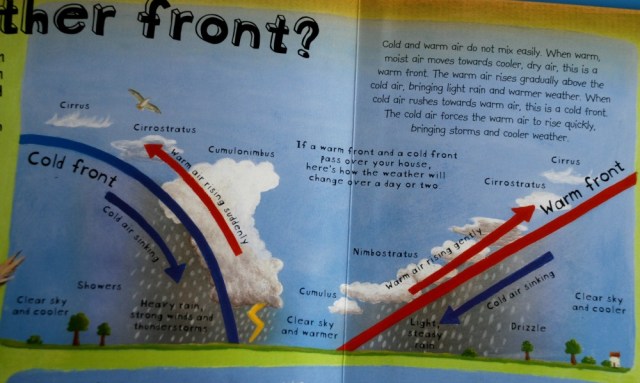
What’s a weather front?

Why does the wind blow ?

how-the-weather-works-jet-streams

How can we predict the weather ?

What is a hurricane ?

how-the-weather-works-what-is-a-hurricane

What is climate ?

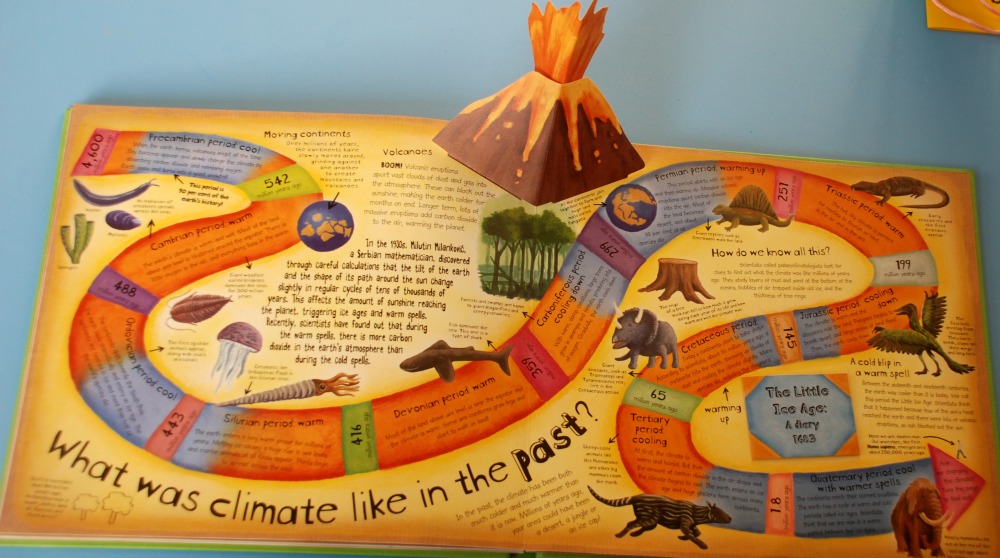
What was the climate like in the past ?

how-the-weather-works-what-was-the-climate-like-in-the-past

Are we changing the climate ?

We are purposely reading this book very slowly as both kids are finding it fascinating and end up asking lots of questions so we really want to try and deal with each set of questions and try to make sure we have covered everything on that topic before we move on.  We tend to do one double page spread at a time, often reading the same pages a number of times.

We have spent quite a bit of time talking about the water cycle and my youngest loves the story of the raindrop.

how-the-weather-works-the-water-cycle

He keeps chirping up with facts like “a raindrop can float around in the ocean for thousands of years.”

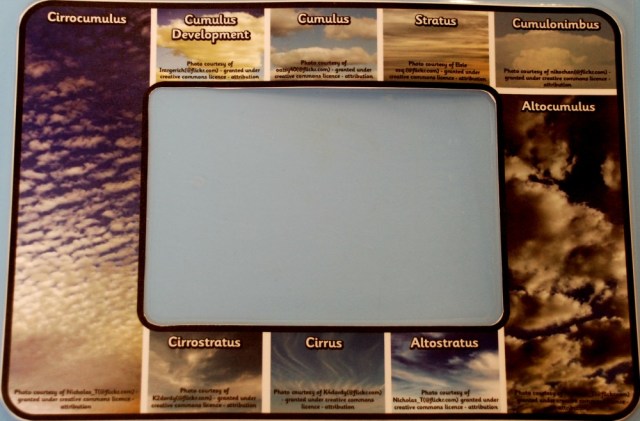
Both kids have also found bits about the different clouds very interesting

how-the-weather-works-cold-front-and-warm-front-and-which-clouds-form

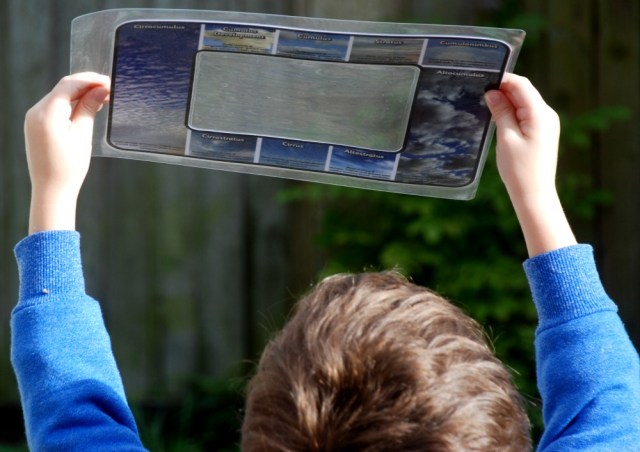
and as a result we have been doing some cloud spotting of our own.

cloud-spotter-from-twinkl-website

We download this fab cloud identifier from Twinkl and the kids have been running outside whenever they spot a good-looking cloud and immediately try to identify which cloud it is.

cloud-spotter-perfect-for-encouraging-young-children-who-are-interested-in-the-weather

We are currently focusing on the hurricane page (not that my youngest gave me much of a choice about that).

The kids and I are really enjoying this lovely book.  And I am thrilled to see that there are other similar ones written by Christiane Dorion.  We are definitely going to be adding a few more of her books to our home-education bookshelves.

how-the-weather-works-book-review

how-the-weather-works-childrens-weather-book

Save

Save

Save

Save

Save

Save

Save

Save

Save

Save

Posted in reviews | Tagged , , , , , , | 1 Comment