KS3 Maths Catch-up Books

I spend a ridiculous amount of time searching online for resources, reading reviews and comparing different items. The main reason is a hate buying a book and then it arrives and it ends up just sitting there not being used. I really hate that.

On one of my many searches for KS3 books I came across a range of Maths books called Catch-up Books. There are 5 in the range and they each get progressively harder. I was intrigued. Not because I thought we needed a catch-up book but because I wondered if we could use these as revision books/ practice books / way to build up confidence and speed.

When we are busy with a Maths section – e.g. Geometry I still like to give me daughter other Maths pages to “remind her” of the Maths concepts that she has already learnt and just to keep practicing her Maths. I am a huge believer in doing lots of Maths practice.

So the idea of these books seemed interesting. I started looking at them an immediately could tell that the first few books in the series where just going to be too easy so I settled on KS3 Maths Catch-Up Workbook 4 (with Answers): ideal for home learning and catch-up (CGP KS3 Maths) and KS3 Maths Catch-Up Workbook 5 (with Answers): perfect for home learning and catch-up (CGP KS3 Maths).

Maths Catch-Up Books 4 and 5 KS3 Maths

The aim of these books is to improve number skills by practicing them over and over again so that the skills are part of the kids long-term memory and they can quickly recall how to do them. Each double page looks the same. The page starts with a brief explanation of a Maths concept. Then question 1 is practice of this concept. However questions 2 to 4 are practice of other concepts that the kids would have already covered and Question 5 is back to the concept covered on this page. 

This slideshow requires JavaScript.

This layout is different to most other books.  In most Maths books a concept is explained and then all the questions on that double page are examples of that concept. The idea behind this layout is the kids do a double page in one sitting so they end up practicing multiple concepts in one day. And the concepts are repeated multiple times over the next 70 pages of exercises so they end up getting a lot of practice over and over again.

This slideshow requires JavaScript.

It is a different layout and one that was new to us but I must admit we like it. We really like it. We are using this book as a way of just keeping older Maths concepts ticking over while we work on new Maths and I do think it is helping because she is constantly practicing over and over.  And by doing 1 double page at a time it is a quick Maths warm-up type activity. And each book only costs me just under £5 (which for the amount of Maths examples included is good value for money).

I have not seen what is included in the first 3 books but I did find this summary at the back of the books, I thought it might be useful in helping you select the correct workbook.

KS3 Maths catch-up Books

I have found Book 4 and 5 a good addition to my KS3 maths resource collection.

Admin Bit – I do include Affiliate links. If you follow an affiliate link and go on to purchase that product, I will be paid a very small commission, however your cost will remain the same. I only include affiliate links for products that we use and love.
Posted in Homeschooling | Tagged , , , , , , | 1 Comment

The Last Wolf. Book and Free Resources

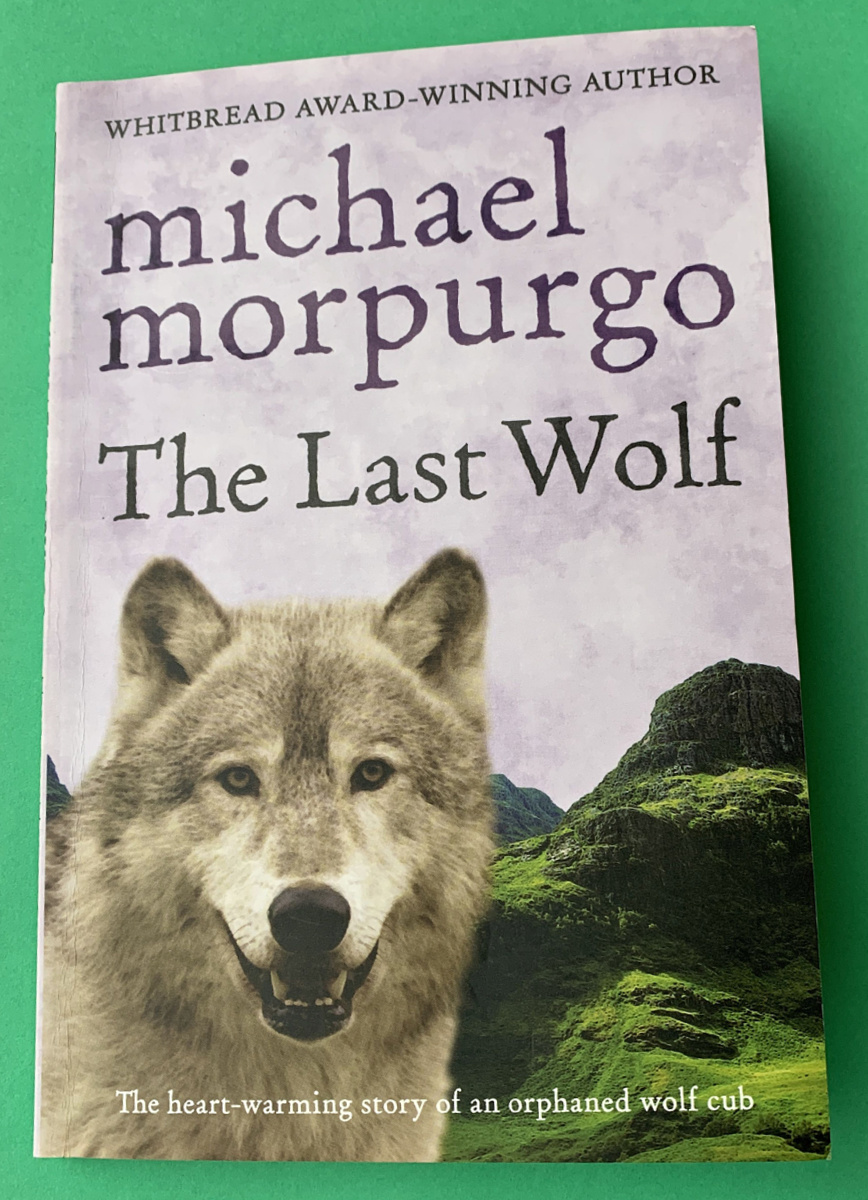
One of the books we choose to read this year was The Last Wolf by Michael Morpurgo. I am not quite certain how we got around to choosing it as one of our books – possibly because we enjoy Michael Morpurgo books, maybe because it includes a wolf (I think my kids secretly wish they could raise a wolf cub) or possibly the fact that the book was written in a Historical period that we are covering this year. Not sure what our initially thinking was but whatever the reason was I am really glad we selected this book.

The last wolf by Michael Morpurgo

The story is about a young boy who has some really tough breaks and has to deal with a lot in his youth (he is an orphan, has a cruel guardian and then when he finds a couple to love him they die), but it is not a story about lose, it is actually a story about survival and not giving up, about finding somewhere to belong and about hope. And yes there is a wolf cub in the story who loves the main character (I think kids who enjoy animal story will love this angle – both of mine did).

The story is shorter than I expected (we actually covered the whole book and all the activities linked to it in 2 weeks and normally our books last for about 4 weeks, sometimes longer), but still well written and an excellent story to read and talk about with the kids. Like how the author shapes the story, changing time periods, using a will and ancestry search as the reason for the time change (I have a feeling mine are going to steal this trick).

For home educating purposes I downloaded the Free to download Teacher’s Pack from the Oxford University Press website (they have a number of Free teacher’s packs that are linked to stories in their Rollercoaster series).

The Teacher’s pack includes a very useful Navigator page – where the story is summarized and broken down into suggested reading sections.

The last wolf by Michael Morpurgo

Then there are lesson plans for each suggested reading section. The lesson plan highlights ideas that you could talk about with the kids. Sometimes it includes things like looking for metaphors, sometimes asking about the characters or how the setting impacts the story.

The last wolf by Michael Morpurgo

And then for each lesson there are 1 or 2 worksheets.

This slideshow requires JavaScript.

This is now the second time that we have used the Teacher Resources from the Oxford University Press site.  And it just makes life easier.  And let’s be honest easier is better. The night before I read the lesson plan, decide what I want to talk about, print out possible worksheets and I am set.  Quick and easy, no fuss. A home educators dream.

And we actually end up covering a lot.  With this book the kids wrote diary entries, book reviews, looked at the use of fonts, how repetition can be used for emphasis, rhetorical questions, they researched wolves, read about Scotland and I am sure I am forgetting some stuff.  But we did a lot and it was all linked to the story and all with very little prep work from me.

The Last Wolf Free download from the OUP site

I think the range of stories they have included in the Rollercoaster series is brilliant and I love how easy it is to use their Teacher Guides.  So yes we will definitely be visiting the Rollercoaster series again, soon.


Posted in Book Ideas | Tagged , , , , , , | 2 Comments

Fraction Packs for KS2

We are massive fans of the Oaka Books Topic Packs. We use them for History, Science and Geography so I was naturally a bit curious to see what their Fraction Topic Packs looked like (they have 2 Fraction Topic Packs).

It’s brilliant – they have a Topic Booklet which explains the fractions concepts, a Write Your Own Notes where the kids get to practice a bit of what they learnt and some cards to go with it.

My son loved that his Maths was turned into a fun topic pack. He found the booklets engaging and interesting (which for my son means he remembered what he read), he enjoyed doing the write your own notes (in fact he asked if more of his Maths could come in this format) and of course the cards where a winner (any card activity always trumps worksheets in our house).

Oaka Books Fraction Topic Packs for KS2 Maths

We started with the first Fraction topic pack and then went onto the second. With the first one we stuck to their exact order but with the second topic pack we did jump around a bit (but as I have said before with all of the Topic Packs I have found you can work through in their order or you can tackle the different sections in your own order – both work).

So what do they cover?

Fraction Topic Pack 1

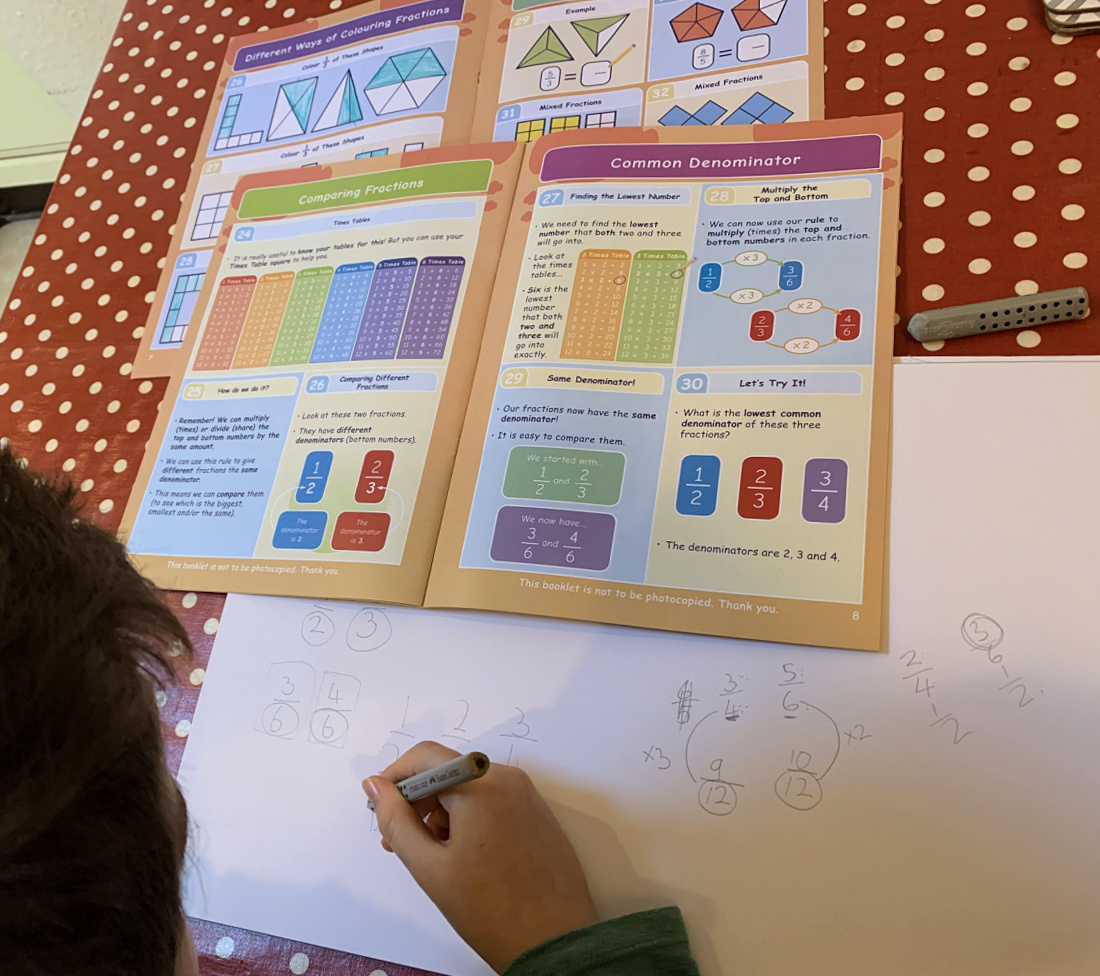
The topic booklet starts with explaining what a fraction is (the numerator vs the denominator, equal parts etc). Then in goes onto simplifying fractions, ordering and comparing fractions, common denominator, mixed fractions and improper fractions. (I would suggest that your kids are happy with their times tables before you start this pack as you use multiplying and dividing for simplifying fractions). 

This slideshow requires JavaScript.

The Write Your Own Notes (think fraction workbook). It starts with pages where the kids need to colour in the correct fraction, then they have to write the fraction for each image and then write the fraction for the image and simplify the fraction. They also include some fraction story sums (I am a massive fan of giving the kids lots of story sum practice). There are some pages where the kids are asked to colour in different shapes to show fractions in a different way.  And onto mixed fractions, then comparing fractions and examples where they need to simplify the fractions. And yes there are answers at the back.

This slideshow requires JavaScript.

The cards included are a number of equivalent fraction cards which they suggest you can play a version of fraction snap with.  We used the cards for a straight forward matching activity.

Fraction Topic Pack 2

The Second Fraction Topic Pack is harder then the first and the kids would need to understand the fraction concepts in the first in order to do the activities in the second.

Oaka Books Fraction Topic Packs for KS2 Maths

The Topic Booklet has a 1 page summary of the concepts covered in the first pack and then it goes straight into multiplying fractions, multiplying mixed fractions and dividing mixed fractions. Then it moved onto adding and subtracting fractions and adding and subtracting mixed fractions (we actually did this section first and then did the multiplying and dividing section). And then a quick summary

This slideshow requires JavaScript.

The Write Your Own Notes starts with a glossary for the kids to fill in (I actually like this idea because it makes the kids think about the definitions). Then worked examples for multiplying and dividing fractions. They include 3 pages called “what fraction is it” – which are basic story sum activities. Onto adding and subtracting examples and finally some more diving fraction practice. And yes answers at the back.

This slideshow requires JavaScript.

The second pack come with a set of cards that have fractions and percentages on them so the kids can use them for a number of matching activities. (Really useful set).

We liked these topic packs. My son enjoyed the way they explain fractions and he enjoyed working through the Write Your Own Notes. However I do want to state the exercises include in the Write Your Own notes are not going to be sufficient as your only source. If you home educate your kids you will need to give them some extra practice pages. (If you look on the TeachitPrimary website you will find some extra Free fraction pages to download and use as extra practice)

I love the fact that they have used their Oaka Books way of doing things to cover fractions and I am hoping that maybe just maybe they will extend their Maths range and possibly come up with a Geometry Topic Pack in the future.

Posted in Homeschooling | Tagged , , , , , , | Leave a comment

Times Table Year 5 workbook

I normally stick with the same resources for both the kids but every now and then I need to change something to better suit my youngest. He is actually quite good with Maths – he always understand the concepts quite easily and is able to apply them to all kinds of situations. But when it comes to times tables he just seems to struggle with remembering them (he can work out the answer quite happily but that does take a bit of time) and I have seen with my oldest that knowing your times tables well really is essential for the older years.

So I bought him this book KS2 Maths: Times Tables 10-Minute Weekly Workouts – Year 5: ideal for home learning (CGP KS2 Maths) as a practice book.

CGP KS2 Maths times table Year 5 workbook

This book is written for school terms. So there are 36 double pages – which means 36 “workouts” (the idea being that you do one workout for each school week). They go as far as labelling the workouts Autumn Term, Spring Term and Summer Term. But like we have done with lots of other workbooks we tend to just ignore the labels at the top of the page. My son is currently doing 4 “workouts” a week so we are NOT sticking to their plan. We actually do the workout as a Maths warmup each morning and then after we have finished the workout we go onto our other Maths. It is just what suits us and our way of making sure he is practicing his Times Table a lot because we are trying to work on them (and we are a bit more than half the way through the book and I actually do feel like he has improved, so much so that I am planning on buying the Year 6 times table book as soon as he finishes this one).

Okay so layout. They call each double page a workout and they allocate them between the school terms. The workouts do get harder as they progress (so the problem sums in the Summer Term are harder than the problem sums in the Autumn Term).

Each double page is split into 3 sections. Firstly they have a number of quick fire questions – which are mixed up times tables.

This slideshow requires JavaScript.

Then there are 3 or 4 story sums where the kids need to apply their times tables and finally they have a more challenging question called a puzzle. Some of the puzzles in the Summer Term section do include Year 5 Maths concepts so if you have not covered that Maths with the kids they may struggle to answer the puzzles in the Summer Term.

This slideshow requires JavaScript.

All answers are include at the back of the book.

In terms of other times table books we have used. I think the Times Tables Practice Book 2: KS2 Maths, Ages 7-11 is easier (it is more what you would use when they are learning the times table.)

But I do think this CGP book (KS2 Maths: Times Tables 10-Minute Weekly Workouts – Year 5: ideal for home learning (CGP KS2 Maths) is easier than the Times Tables Tests Book 2: KS2, Ages 7-11. I still really love the Schofield & Sims Times Table Test book but I felt like my youngest needed some extra practice.

Admin Bit – I do sometimes include Affiliate links. If you follow an affiliate link and go on to purchase that product, I will be paid a very small commission, however your cost will remain the same. I only include affiliate links for products that we use and love.

Posted in Homeschooling | Tagged , , , , , , | 2 Comments

KS3 Maths Study Guide

Most of the KS3 Maths resources that my daughter uses are worksheets downloaded from websites and a few extra practice pages from some activity workbooks. But last year I realized that she needed a Study Guide, something that she could keep and refer to when she just wanted to double check something or remind herself of something (she likes to try and figure out things herself so I want to give her the tools to do that and of course I am here to work through and explain things). I suppose I would call it a “text book”. A book with explanations and worked examples in it.

I searched and immediately found this KS3 Maths Study Guide – Higher: ideal for home learning and catch-up but I was initially reluctant to buy it for her because she did have some CPG books before and she never liked the format. I searched some more but I kept coming back to this Study Guide and since it was under £5 I thought, lets just try it and if I find something better later I will replace it.

Key Stage 3 Maths Higher Level Study Guide

Well, it is exactly what we wanted. And my daughter is happy using it.

So what can you expect?

Each page tends to be a topic, the concept is explained at the top, then they have some worked examples and at the very bottom they have a couple of examples that the kids can try (yes there are answers at the back of the book). And at the end of each section there is a revision page. But before I go further I want to stress there are only a few examples for the kids to try. This is NOT a practice book, or as some would say a workbook. It is an Explanation book. You will need to buy another book or download worksheets which contain examples for the kids to work through.

This slideshow requires JavaScript.

The book itself is split into 6 sections

  1. Numbers
  2. Algebra
  3. Graphs
  4. Ratio, Proportion and Rates of Change
  5. Geometry and Measurement
  6. Probability and Statistics

It is everything the kids need to know for KS3 Maths (Years 7, 8 and 9).

So for someone who is not normally a fan of CGP books – why this? I really wanted my daughter to have a reference guide, a book with all the explanations that she needed together in one source.  Something that she can turn to and read.  And it works.  The explanations are clear and concise, the worked examples are well explained.  It is exactly what I wanted.  So much so that I actually ended up buying my youngest a similar KS2 version.

Do I think you have to buy the CGP workbooks to use with the study guide. No.  We use this study guide with other sources (Twinkl worksheets, TeachitMaths worksheets, Collins books) and it works perfectly.

Admin Bit – I do include Affiliate links. If you follow an affiliate link and go on to purchase that product, I will be paid a very small commission, however your cost will remain the same. I only include affiliate links for products that we use and love.


Posted in Homeschooling | Tagged , , , , , , | Leave a comment