An Inspector Calls Revision Guide from Twinkl

One of the IGCSE English Literature books (well actually play) that we have selected is An Inspector Calls. So over the last few months I have been gathering the different resources that we are going to use with it and one of the resources is this Revision Guide from the Twinkl website. I first stumbled across these GCSE English Literature Revision Guides by accident when we were working through Macbeth and I loved the Macbeth Guide so I knew I wanted to use these guides for our IGCSE English Literature works.

The reason why I like these Revision Guides is because it sets out everything that you need in a easy to read format. And it includes some great exam type questions and importantly it includes sample answers where they discuss what is good about the sample answer and what could be improved (something which at this level is very important for the kids to read and think about).

Okay so this really is a revision guide that includes everything. It starts off with a bit about the exam which I am not going to go into then it is about the author – know this is actually quite important, by understanding a bit about the author, and his background you get to understand some of the themes of the play. We have already spent quite a bit of time just talking about the play writer, his concerns and the historical context of this play as it really is vital to understanding what the play is about. So I was really glad that this was included and included right at the beginning because it is actually your starting point.

Next it’s form and structure, again something which is important and then onto the Who’s Who. Know I must confess in all of these Revision Guides I love the Who’s Who pages. I just love the quick summaries of the main characters and always find them concise and spot on (We actually like to use these pages to add in a few of our own points and quotes).

Then the Summary pages. Again exactly what you need, quick concise and spot on summaries of the three acts. And lets be honest when it comes to revising this is exactly what everyone is after a good, short summary of the main points in each act. And I love that the at the end of each Act summary they include a block called Chain of Events – who ever thought of putting this here, was brilliant.

Okay so these pages are really wrap it all up very nicely. But then we go into a bit more detail and cover Four Themes of the play – Social Class, Gender Roles, Age and Time and Morality and Legality. Each theme is broken down into – Context (background info – vital), Key Quotes (really useful), Mini Exam questions, Exam Questions and the Sample Answers (the sample answers are a must read, really do yourself a favour and if you read nothing else read these and look at the comments about the sample answers).

All in all you are looking at 81 pages, which is quite a bit but honestly all of it is worthwhile.

I think these Revision Guides from Twinkl are a must use item for all of you with Twinkl memberships, they really are well written and they have included all of the key items that you need to cover.

Admin – this is an independent post, and was NOT requested by Twinkl. This just happens to be a resource that I like and find useful.

Posted in Homeschooling | Tagged , , , , , , | Leave a comment

I am tired but no they are not going to school

One of the things that frustrates me about home education is the way “others” view it, by others I mean those who do not home educate. They never seem to grasp that it is something that families truly believe in, so they have a tendency to always advise the home educator to quit. If the home educator ever thinks to utter the words “It was a rough week” or “This week I have been feeling rather tired” or “I am not sure about …” Then the response it the standard “well, I think that it is time you put them back into school.”

Now lets just take a step back and think about something. If a wife says something along those lines about her husband, do you automatically tell her “well, I think it is time you divorced him”.

If a working person says something along those lines about their job do we tell them it is time to quit their job?

So why is that the default setting when it come to home educators. Why can they not admit that they are having a hard week or even a hard month without someone encouraging them to just give up. And why is the advise to give up instead of some kind words of encouragement?

I have thought a lot about this over the 11 years we have been home educating and I think the reason is because non home educators still feel that school is the right place for ALL kids and they have not really understood that sometimes school is just NOT an opinion. (And yes I promise the home educator knows about the schools in the area – there really is no need to start telling us about some school that you think we have never heard about, we did not chose to home educate because we failed to notice the local schools.)

So next time you see that home educator looking exhausted and looking like they would really love to quit, try and put yourself in their shoes. Think if you had a kid for whom school was not an opinion, would you just give up or you would also keep fighting for your kid to have the kind of education that they need.

And if you can not put yourself in their shoes then please remember that old saying – “If you have nothing nice to say then just say nothing”. Honestly rather just nod your head, keep your “helpful comments” to yourself and walk on.

Posted in Homeschooling | Tagged , , | 1 Comment

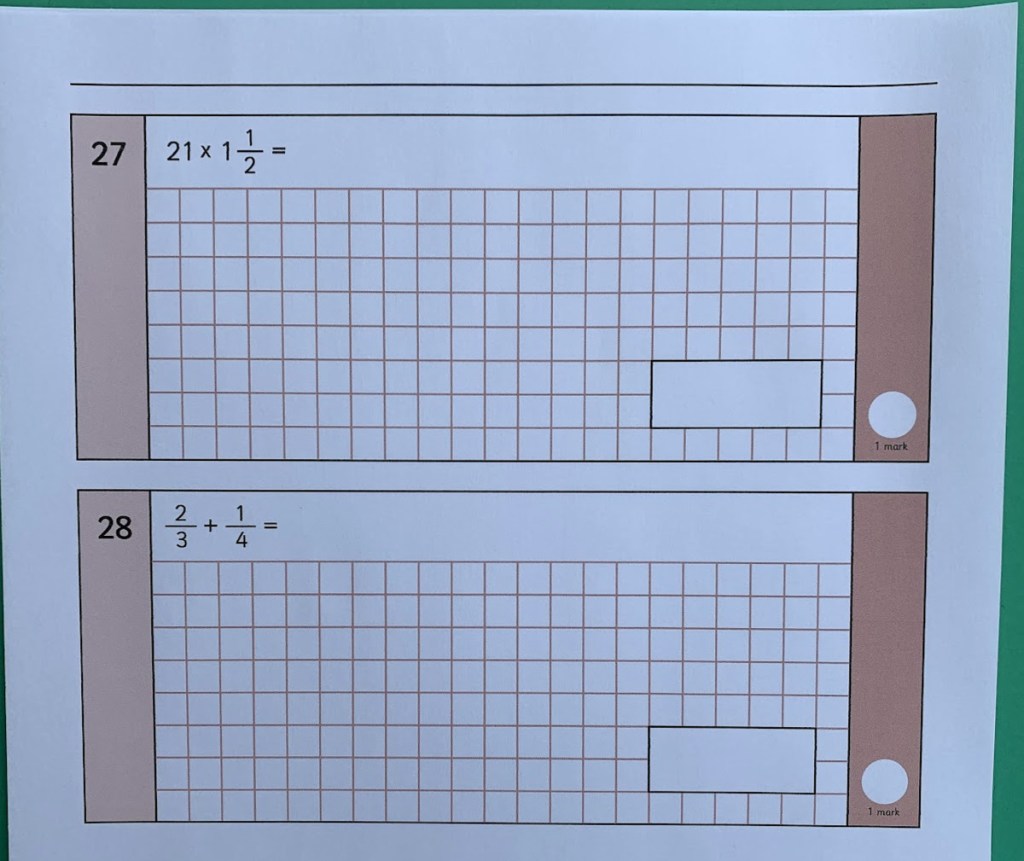
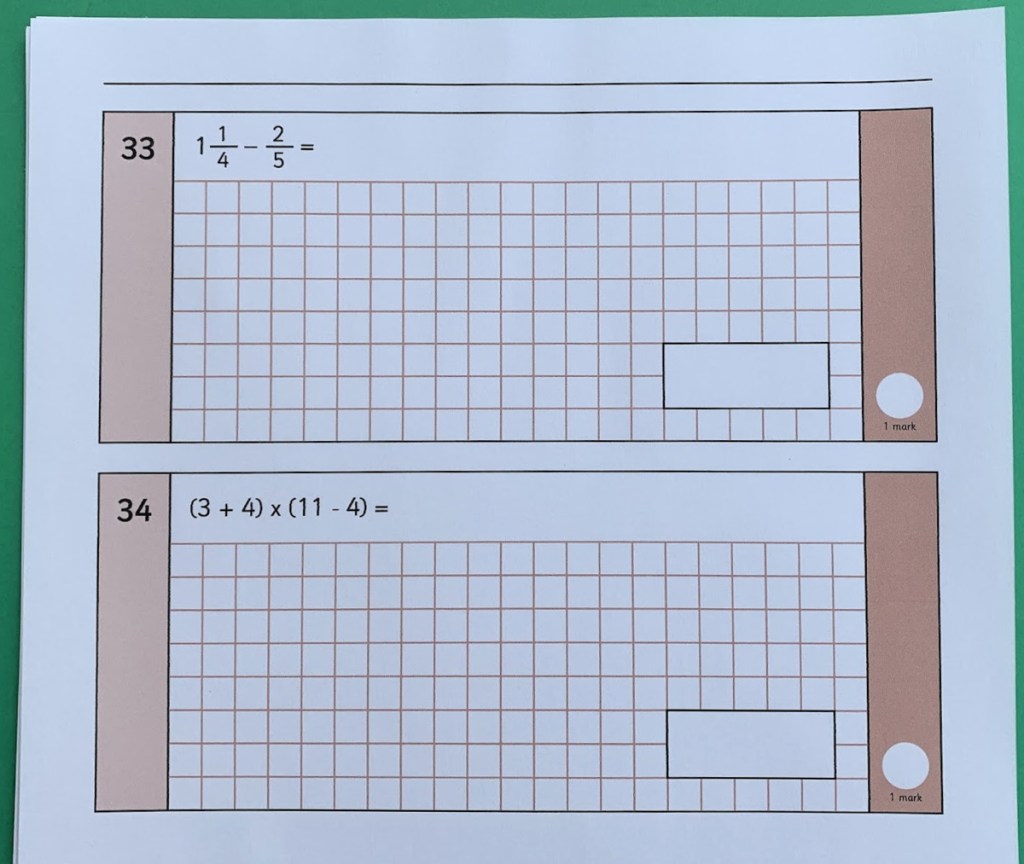
Key Stage 3 Maths, 10 minute test books from CGP

I have to admit we never did “tests” as such when the kids were younger – I really did not see the point as I already knew how they were progressing and I knew which areas we needed to work on. But as they progressed into their Secondary years I started to bring in the idea of tests, mainly because I wanted them to get used to the idea of a test not being such a big deal. And when I was looking for “test” papers I spotted these 10 minute books from CGP and I bought 2 to begin with and then bought a whole bunch more. (I bought mine from Amazon but I have spotted them in a few bookstores).

I find these 10 minute test books really useful for a number of reasons. Firstly let me state they always include the answers at the back of the book (which I love because I like getting the kids to mark their own tests so they can see where they went wrong). Secondly the questions included are always varied, so they get to practice a number of different skills while working through just one test book. Thirdly although they are only written as 10 minute tests if you want to get the kids to sit for longer you can always get them to do a few different tests in one go, we have done that a few times as it works really well.

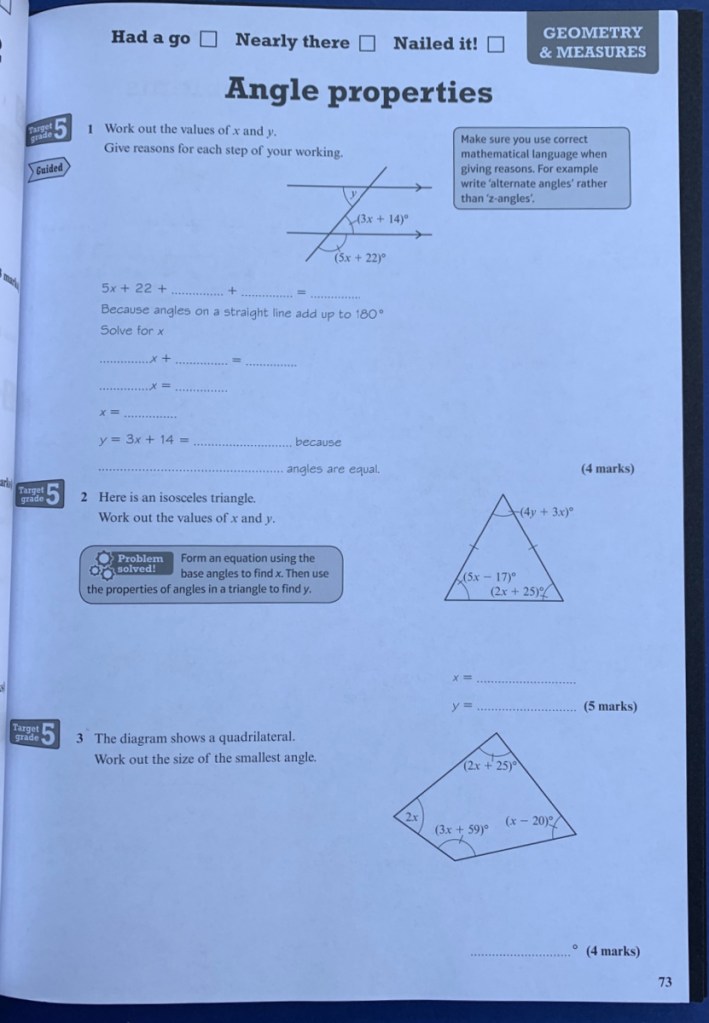
Okay so in the Mathematics for Key Stage Three 10-minute test book two you get the following tests.

That end up being 31 Maths tests all in this one little book.

Each test is spread out over a double page and they truly are tests which the kids can do in 10 minutes, so they are a great way of included quick tests into your learning.

I must admit for someone who was never that interested in getting the kids to write tests when they were younger I am now finding these little 10 minute test books very useful. We often jump around and find a test which covers the area that we have been working on, but you could also just get the book towards the end of your learning year and use them as revision tests (I am planning on using a different Maths test book with my son to do just that). However you plan on using them I do think they are a good educational tool.

Admin – For anyone interested this is a book I bought myself. I do include Affiliate links. If you follow an affiliate link and go on to purchase that product, I will be paid a very small commission, however your cost will remain the same. I only include affiliate links for products that we use and recommend.

Posted in Homeschooling | Tagged , , , , , | 1 Comment

Get Children Writing

A few weeks ago I heard about a new book – Get Children Writing by Sue Walsh and I was immediately interested because this is actually one area in which I have struggled to find good books for my kids. What I mean is you will find lots of English grammar or English comprehension books for kiddos but a book with good, interesting writing activities, a book which is written with the aim of getting kids to express themselves and to enjoy writing is incredibly hard to find. So with all of that in mind and the fact that this is an area that I wanted to try and work on with my son I asked if we could review this book.

The first thing that struck me after paging through it – it is a book with ideas and you the home educator or parent can really take these ideas and adapt them to your kids (or you can just stick with the ideas as they are because they are great as is). But what I immediately liked was the fact that I could see that as a home educator you can use this with different aged kids, in fact after looking at a few of the ideas I was already thinking of ways I could slightly alter them for my oldest (extend it a bit and make it a bit more challenging for her).

The book is broken down into three categories – Introduction activities (think inspiration), Poetry and then Extract from Children’s Classics and has 22 different writing activities in it.

Now after using this book for a bit with my son I would strongly suggest that you actually work through some (if not all, because they are great) of the activities under the Introduction section. These really are excellent “starter” activities. I was really very impressed with what they included under this section and I must admit my son did not complain about these activities (which is actually really impressive as he often chirps when I try and set him writing activities).

Then the Poetry section (as I have mentioned countless times before Poetry is not one of our strong areas in this house) but this poetry section was brilliant, I loved it and I thought it was really well explained and I liked the way it encouraged the kids to try and write their own poems.

Lastly Extracts from Children’s Classics. Now please don’t think comprehension, this is NOT that. These extracts have been chosen as examples of good writing and the kids are encouraged to think about why they are good pieces of writing and then try and use that in their own writing. Again an excellent section.

Content wise, I really think these are brilliant activities. Really impressed.

Now layout. There are no model answers in this book, but then it would be very hard to include model answers when it comes to writing. However with most of the activities they either include examples or teacher’s notes. Which in a way form as a sort of model answer. If you read the examples or if you read the teacher’s notes then you can judge if you are on the right track with you answer.

I have been really impressed with this book – Get Children Writing and I think it is a brilliant resource with enjoyable and inspirational ideas.

Admin – As I mentioned above I asked for a review copy of this book because I was really interested to see if it was worthwhile.

I do include Affiliate links. If you follow an affiliate link and go on to purchase that product, I will be paid a very small commission, however your cost will remain the same. I only include affiliate links for products that we use and recommend.

Posted in Homeschooling | Tagged , , , , , | Leave a comment

How do I plan for our Secondary subjects

This seems to be quite a common question so I thought I would try and explain my planning process in a post. This is how I have planned for our Secondary years (so KS3 and now our GCSE years) and NOT how I did it for younger years. For the younger years of home education I really don’t think you need to do such detailed planning and in all honesty I only really started doing this level of detail once we knew our daughter was going to write her exams and I wanted to make sure we laid a good foundation in her KS3 years and now in her year 10 my planning has become more detailed as we are working to an exam deadline.

I plan in a Top-Down manner for her subjects. So we always start with which subjects we are going to cover. Then we work out what is the content and how what is our time frame. So for example in her Year 9 we had a History book that we wanted to work though so it was the content of that book split over 1 year. However in her Year 10 a lot of the books that we have actually contain the content for Year 10 and Year 11 so we have now split that over 2 years (well actually over 18 months as I have planned for us to finish everything and early so we can include revision).

We like to work in 6 week cycles. Honestly it is just something that we have discovered works well for us. We tend to do 6 weeks of work and then have a week or 2 week break and then do another 6 weeks. The fact that we choose 6 weeks is our personal preference so you can choose whatever time period you want. I just find after 6 weeks both the kids and I need a break. So I then tend to take the total content that I want to cover over our year and split it between 6 sets of 6 week cycles. This means I now have a rough idea of what we need to cover in a 6 week cycle. This helps me a lot. I like to break everything down into smaller chunks. I actually write out a small very high level summary of what I want to cover in every 6 weeks

eg Biology – Ecosystems and revision of nutrition

Very High level but it helps me to write it all out

Okay so lots of people would just be happy with that amount of detail – the fact that they want to cover topic x over the 6 weeks and leave it like that.

But now that I have one kid in year 10 and my other kid already thinking about writing his exams early I feel like I need more detail that just topic x over 6 weeks. So I have a very simple spreadsheet which I set up with a tab per week.

It is very simple but it allows me to split our 6 weeks into what we want to do each week and each day. And in case you are wondering – no we do not always stick to it, it is a guide, I will often move things around. Also I know that on certain days we have other activities on so on those days I tend to plan less and then plan more on our “home-days”. But really it is my guide and I often juggle and move around as we are working. (and in case you are wondering the photo was taken while I was still planning so I had not included Maths and English yet or any of my 2nd kiddos stuff)

I have include the plan for both kids on the same tab – I just find it easier to see everything on one tab at one go.

I hope that answers some of the questions. But I do want to stress that just because you create a plan does not mean you need to stick to it. For me a plan makes me feel like I am in control and helps me to not get overwhelmed. But if something comes up and we want to go out to do a fun activity which is not in my plan, I change it, I don’t let the plan control us.

Posted in Homeschooling | Tagged , , , , , | Leave a comment