Horrible Histories Book Set

One of the things we have found tough about the lockdowns has been the limited library access. Both my kids are bookworms and although we use eBooks for learning they both find reading stories on a screen a bit exhausting, so for fun, relaxing reading we stick to books. But they both read at a ridiculous pace and at the moment although we can reserve books at our library it is all happening a lot slower, so I have been searching for books to buy. But I like buying book sets and I don’t have excess to cash at the moment so I needed to find a source that could supply book sets at a good price. I searched and stumbled upon a website called Books2Door. And when I looked on their site I immediately found a number of sets that I knew my kids would enjoy and they were well priced (a few that I spotted on my first look were – Roman Mysteries, Warrior Cats, Horrible Geography and Horrible Histories). So I thought it would be good to test them out.

We went with the Horrible History set.

This slideshow requires JavaScript.

It is £3.99 postage for orders under £35 and free postage for orders over £35. The order arrived on the day that they said it would and it was in good condition – no complaints about delivery at all. And really £28.99 for 20 different Horrible History books is a good price.

horrible Histories books

The kids were thrilled. They loved the fact that we got the whole set so they could start at the beginning and work their way through in order (which strangely is a new thing with both of them, the never used to worry about reading books in order but lately they really want to stick to the order that the authors write in).

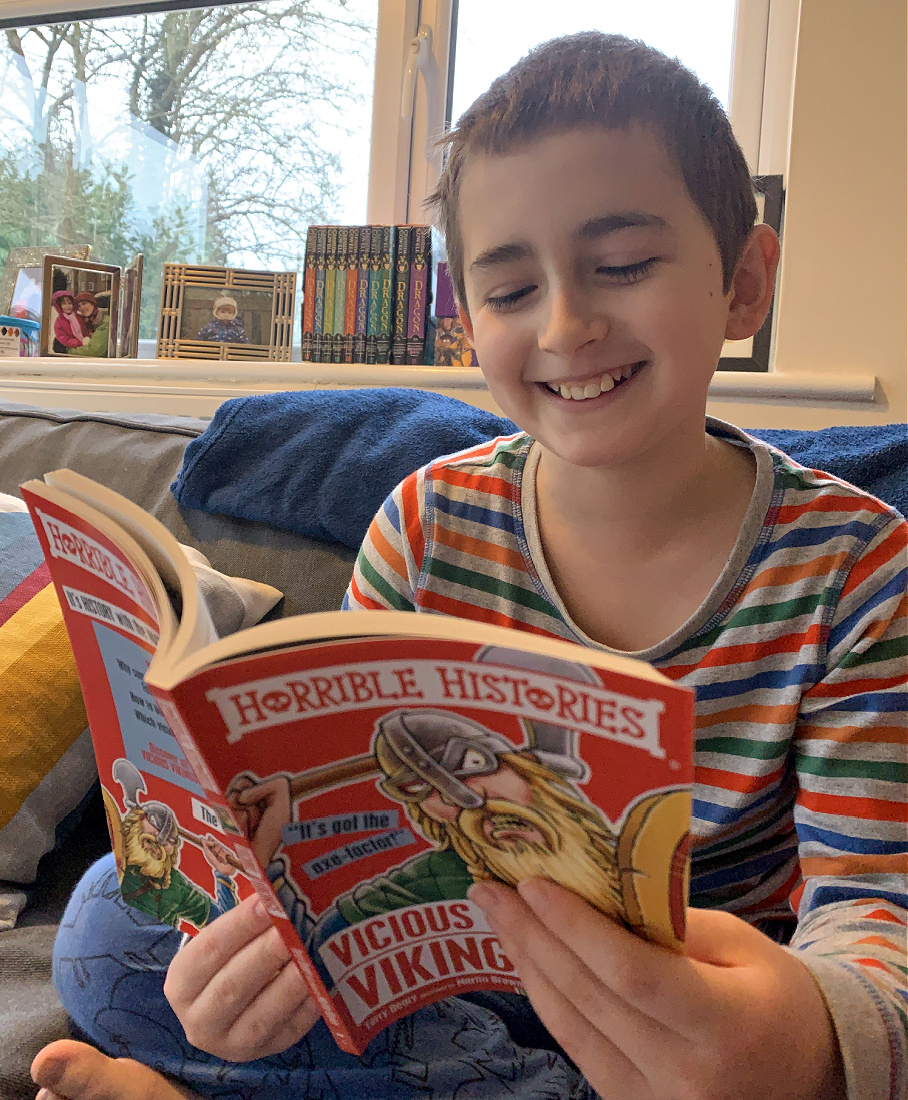
The Horrible Histories set itself is brilliant. My youngest (aged 10) is not a huge History fan like his sister but he does enjoy learning about the stranger things and yes the gross side does fascinate him. So these books have been perfect for him. And he LOVES, really LOVES that they include a “test your teacher” section in each book. He always come up and quizzes me and is thrilled when I don’t get all the answers correct.

This slideshow requires JavaScript.

I was not always convinced about the Horrible Histories way of sharing events and characters but with everything going on at the moment, my youngest has really needed a more “entertaining” style of learning. And in all honesty, he just reads and reads these books and he remembers what he has read because it is so fascinating. So really he is actually doing a ridiculous amount of History all by himself and he is also entertaining himself (and entertaining us when he reads out some of the extracts).

I am very impressed with this box set and I am impressed with the price of the books. We will definitely get a few more book sets from Books2Door, the only problem is trying to whittle down which ones to buy.
Admin Bit – I searched the internet and found out about the Books2Door website. After I chatted to the PR contact they kindly sent us some books.

Posted in Book Ideas | Tagged , , , , , , , | 4 Comments

Phyllis and the Fossil Finders. A Twinkl eBook

It is strange it think it is only January and yet we are all already feeling exhausted and a bit fed up with the current set up for home education (I have said this before and I will keep saying it – this lockdown style of learning is NOT home education and even us “normal” home educators are struggling with being cooped up and stuck at home this much). So I am trying to add in as many learning activities that I know my kids enjoy and I am trying hard to vary what we do week to week.

One of the big winners last year were the Twinkl eBooks and their activities so last weekend I asked my youngest if we should try one and he was immediately keen. We went onto the site (this is the place to go to see which eBooks they have – Twinkl eBook library) and he selected Phyllis and the Fossil Finders.

Phyllis and the Fossil Finder resources from the Twinkl website

As always there are a bunch of  linked activities to the eBook including some grammar pages and topic pages (about fossils) and of course they have the guided reading questions to along with the story. But I must admit the week before we had actually done quite a bit on fossils, including how they are formed so we actually did not go down the fossil angle.

This slideshow requires JavaScript.

Instead we focused on the creative writing side and character aspect of this book. And after reading just a few pages I actually called my oldest (who is Year 8) and suggested she come and read it with us. Okay I am sure a lot of you think that is strange. But the way the story is written really appealed to me, the writer drops these hints about the characters without coming out to say this character has sensory issues or this character has this illness etc, they just mention little bits here and there that build up these characters. And I thought it was an excellent example for my oldest in terms of how she could drop these hints about characters in her own writing.

She actually ended up reading the entire eBook with us and we had a few discussions about how writers can drop hints without coming out and saying something and how it is actually fun for the reading to piece together these bits of information.

And just because she was enjoying the eBook so much when I gave my son the comprehension to do I actually searched the KS3 comprehensions and found one on Mary Anning which tied in perfectly with the book. So she also got to do an age appropriate activity “linked” to the eBook.

Sticking with the creative writing angle. We downloaded the Character profile pages that are linked to the eBook and then I also searched Twinkl and found a number of other character writing pages that we printed out (these ones – Character Traits, character description checklist, character description word mat and physical appearance adjectives). I love that about these eBooks, they always link activities to the eBooks but you can always extend those activities with other pages from the site (we always do this). I purposely printed out the character planning page that has blocks on it and asked both kids to first jot down some key words before they write up a character profile. The reason I did this is my kids don’t plan before they write. They both get these ideas for writing and then just dive it and write away and then half way through they want to change something. So I am trying to get them to do a bit of planning first (trying being the word here, not sure that the planning part has sunk in yet).

This slideshow requires JavaScript.

We all loved the story of the creature who came to life. And I do think it is an excellent price of writing to read with the kids and talk about ways that they can describe and drop hints about their own characters in their creative writing.

We really do Love these eBooks and I have already promised that as soon as we finish our next book (The Last Wolf and activities linked to it) we will choose another eBook.

Posted in Homeschooling | Tagged , , , , , | Leave a comment

Maths Revision Books Year 7 and Year 8

When I first started on our home education journey I spent hours sitting in local book stores paging through the different workbook options that they had on their shelves. And there are some really good ones but for the most part what you find in a WH Smith or Waterstones are actually what I call Revision workbooks. They are workbooks written for kids who attend school, so they include some examples and answers but not a lot. A workbook written for the whole school year may include all the topics covered in that academic year but there will never be enough examples for a full-time home educator. These books cannot be used in isolation (ie they can not be the only source).

When it comes to my daughter’s Year 8 Maths we are using a number of sources. And the main reason for this is I like her to get to used to the different styles that everyone has. A geometry page from the Twinkl website looks different to one from the TeachitMaths website, and they both look different to the geometry pages in the Collins workbook and the CGP books (I must admit we do not always like the CGP style but we do have 2 of their Year 8 books which I dip into every once and a while). I have also noticed that different publishers tend to word the questions a bit differently and sometimes tend to even focus on different points within each topic. So for us, using more than one source is really beneficial.

The majority of her Maths pages are from the two sites – Twinkl and TeachitMaths. And they both tend to have lots of examples. But I still like to get her a Maths Revision book for each year and we actually use it as a Maths Revision book (ie she works through the pages in her revision book once we have completed the topic).

Our favourite of these “Revision workbooks” tends to be the Collins books – the pages are clearly set out, they normally include enough writing space, they have the answers, they include problem sums which I really like and I have never found duplication between what is included in a Collins workbook and what is included on the 2 websites that we use. So the examples are always new examples.

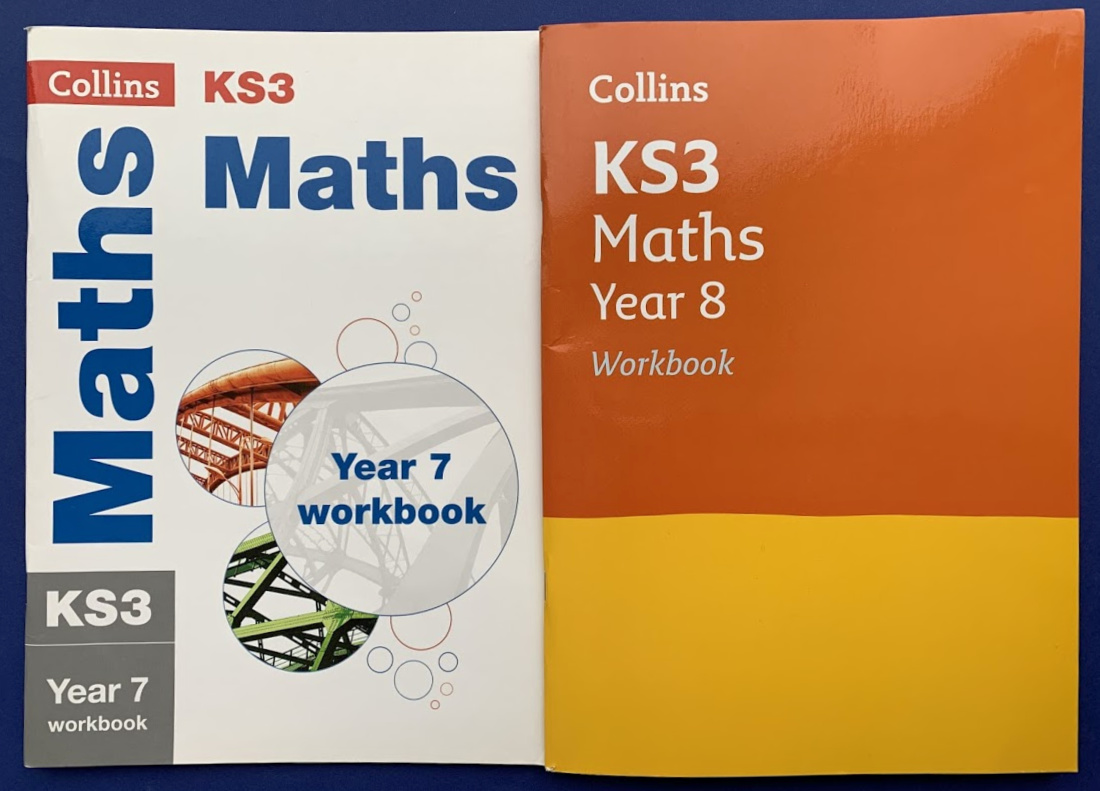
Collins Maths workbooks for Year 7 and Year 8

So for those of you look for a Maths Revision book to use this is what is covered by the Collins workbooks.

KS3 Maths Year 7 Workbook: Prepare for Secondary School (Collins KS3 Revision)

  • Using numbers – negative numbers, problems with train timetables, distance, bank balance.
  • Sequences
  • Perimeter, Area and Volume – includes cuboids and compound shapes.
  • Decimal numbers
  • Working with numbers – squared and cubes numbers, converting units.
  • Statistics – bar, line and pie graphs.
  • Algebra – creating expressions and simplifying them.
  • Fractions – all 4 operations.
  • Angles – missing angles in triangles, quads, around a point.
  • Coordinates and graphs – includes all 4 quadrants.
  • Percentages
  • Probability
  • Symmetry
  • Equations – an extension of the algebra pages, how to solve for x.
  • Interpreting Data – an extension of the graph pages, understanding what the graphs tell us.
  • 3D shapes
  • Ratio

This slideshow requires JavaScript.

KS3 Maths Year 8 Workbook: Prepare for Secondary School (Collins KS3 Revision)

  • Working with numbers – negative numbers, BIDMAS, squared, cubed numbers, HCF, LCM.
  • Geometry – missing angles and translations.
  • Probability – some good problem type examples.
  • Percentages – using percentages including percentage decrease and increase.
  • Sequences
  • Area of 2D and 3D shapes -parallelograms, trapeziums, kites cuboids.
  • Graphs – plotting an equation on a graph.
  • Simplifying numbers – rounding to significant figures, standard form.
  • Interpreting Data – what are the graphs telling us.
  • Algebra – expand brackets, writing equations for shapes.
  • Congruence and Scaling
  • Fractions and Decimals – practice of the 4 operations with decimals and fractions.
  • Proportions
  • Circles
  • Equations and Fractions – solving equations.
  • Comparing Data

This slideshow requires JavaScript.

I hope that helps anyone looking for a Maths revision booklet (but please the key is revision these books have 70 pages in them, they are not a complete curriculum)

I do include Affiliate links. If you follow an affiliate link and go on to purchase that product, I will be paid a very small commission, however your cost will remain the same. I only include affiliate links for products that we use and love.

Posted in Homeschooling | Tagged , , , , , , | 2 Comments

Animal Knowledge Encyclopedia

Someone once told me that kids can never have enough books. And although I agree with that, when I look at our collection of books, we really do have a lot of animal books, a LOT. So when my daughter asked for yet another animal book for Christmas I was a bit reluctant. But she asked for a specific one – the DK Knowledge Encyclopedia Animals and she really wanted this one because she already has the Human Body version of the series (which is amazing) and we recently borrowed the Dinosaur version from the library which was also amazing so she was convinced the animal book in this series was very much required reading.

What is it about this series that my kids love? I think it is the visual feeling of these books. The photographs are incredible and some of the detail, wow the detail – like the little hairs on a mosquito, the complex eyes, the wings of the dragonfly. They really are stunning pictures and they make every creature seem fascinating (even the ones I don’t actually like).

This slideshow requires JavaScript.

My kids also like the way the details are explained and depicted with diagrams.

This slideshow requires JavaScript.

There is a lot of detail included in this book but it is done in a visual format and it is this visual format that really wins over both of my kids and me (yes I will admit that even though we had a ridiculous number of animal books in our house this is a stunning book and I can understand why my daughter wanted it as one of her Christmas presents).

This slideshow requires JavaScript.

The entire book just seems like you are stepping into a photographic wonderland.

This slideshow requires JavaScript.

My daughter tends to read sections at a time whereas my son has actually gone from page 1 and is slowly working his way through page by page. Both methods work with this book, you can start at the beginning or you can just find the sections that you want.

For those who want details. The books starts with some introduction pages like what is an animal, evolution, the animal kingdom and then it splits into 6 sections.

  1. Invertebrates
  2. Fish
  3. Amphibians
  4. Reptiles
  5. Birds
  6. Mammals

And after the Mammals section there are a few pages on Animal Science – habitats, food webs and migration.

This slideshow requires JavaScript.

This book normally sells for around £18.99 and after seeing how much my kids have read and reread it just since Christmas it has already been worth it. We bought our copy from Amazon – Knowledge Encyclopedia Animal!: The Animal Kingdom as you’ve Never Seen it Before

Admin Bit – I do include Affiliate links. If you follow an affiliate link and go on to purchase that product, I will be paid a very small commission, however your cost will remain the same. I only include affiliate links for products that we use and love.

DK Animal Knowledge Encyclopedia

Posted in Homeschooling | Tagged , , , , , , | 2 Comments

Written Calculation Books for KS2 Maths

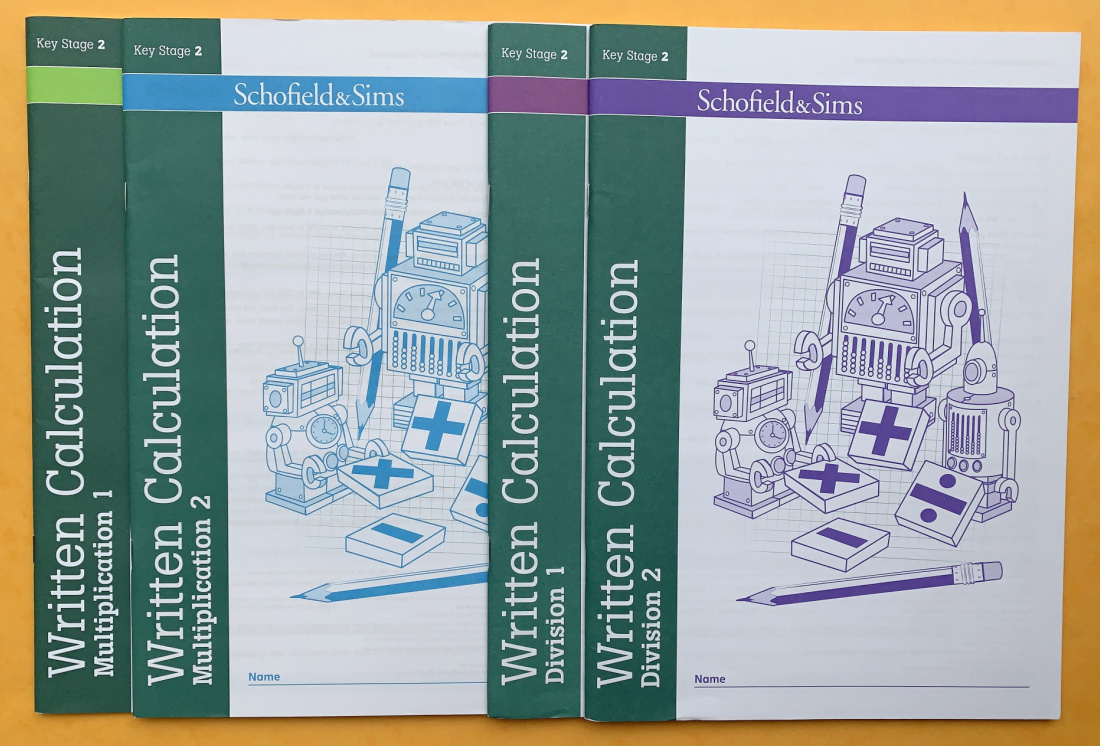
I used the Written Calculation series with my oldest when she was in KS2 and I have been using the exact same series with my son. The series consists of 6 different workbooks (they also have answer books and teacher’s guides but we have never needed those).  The books in the series are – Addition, Subtraction, Multiplication 1, Multiplication 2, Division 1 and Division 2.

This series is straight forward teaching the kids how to do the four operations and then giving them a chance to practice them and become confident using them. I always knew that making sure the kids mastered the basic four operations where important but now that my daughter is in secondary school I really can say it is vital. Making sure they understand and are totally confident with these 4 operations in a key parts of KS2 Maths and one of the foundations for them to move into KS3 Maths. And me these books do just that they allow the kids to master the 4 operations.

My son (who would be Year 5 if he attended school) is currently working through the Division and Multiplication books in this series. So I thought I would explain a bit about these books – but really think – lots of practice, getting gradually harder and more advance with each step.

Written Calculation Books for Divsion and Multiplication of KS2

All the books in the Written Calculation series are set out in the same format. Double pages with a worked example as an explanation at the start of each page, then some examples for the kids to work through and finally between 2 to 4 problem solving questions. The explanation at the top of the page means the kids can actually work through these books independently (which is very helpful).

This slideshow requires JavaScript.

Multiplication 1 – Is the column method for short multiplication (if you are not sure what I mean by that it is multiplying by single, double or triple digit numbers but with only one line answer.  In Multiplication 2 the kids do long multiplication where they end up with two lines of answers that need to get added together, hence it is called long multiplication)

This slideshow requires JavaScript.

Multiplication 2 – Goes from the short multiplication of the first book into long multiplication and includes examples where you are multiplying decimals.

This slideshow requires JavaScript.

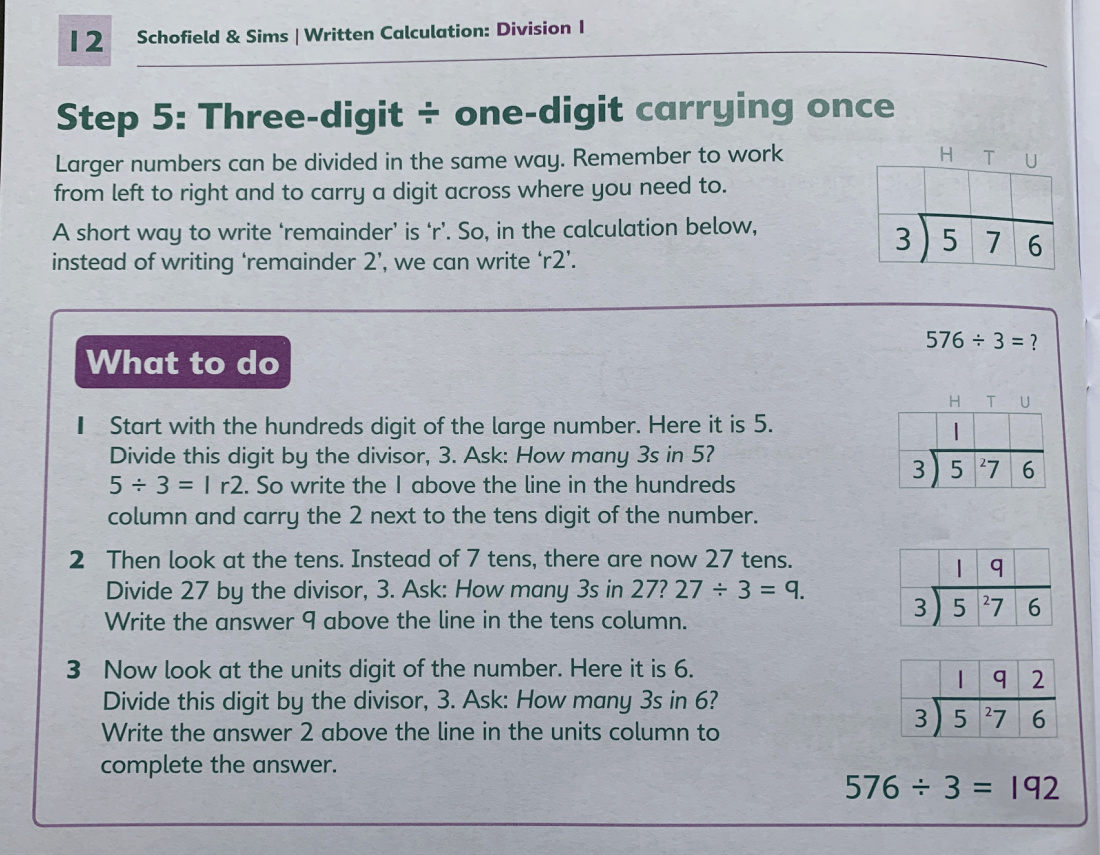
Division 1 – Is short Division (some people refer to this as the bus stop method). It includes answers with remainders, writing remainders as fractions and extending the numbers into decimals.

Written Calculation Books for Division and Multiplication KS2

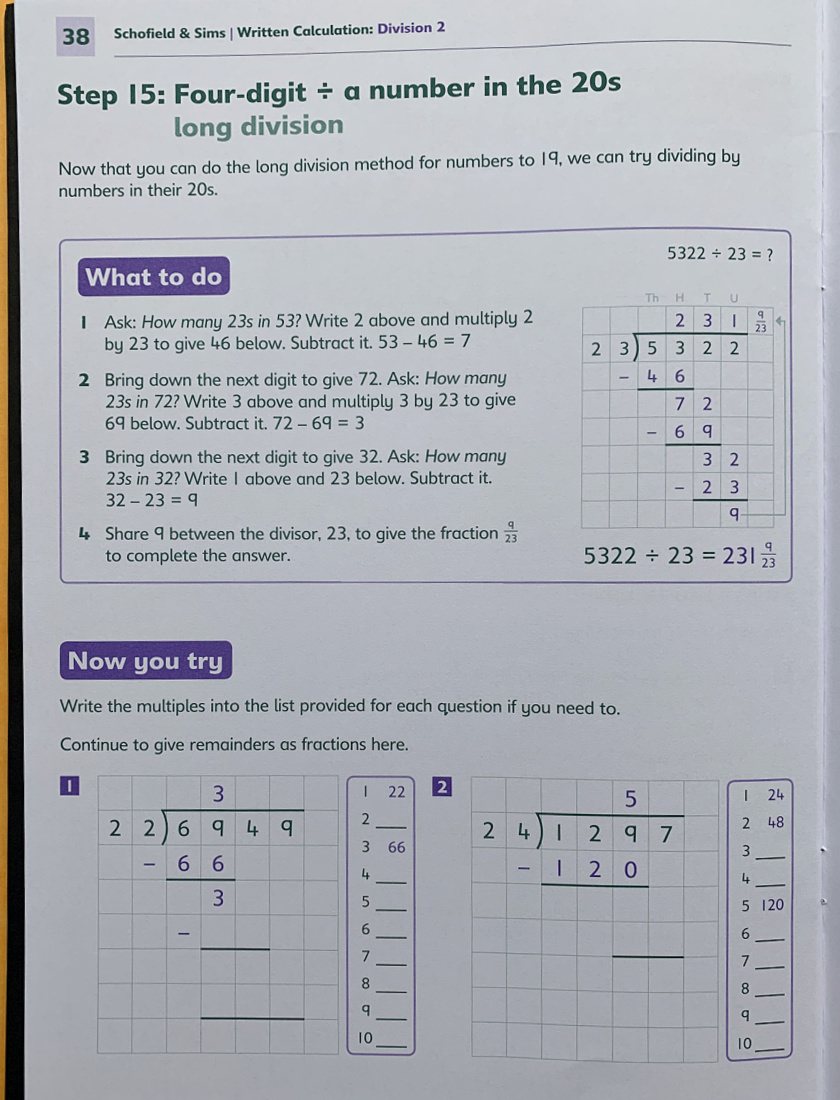
Division 2 – Goes from the short division of the first book into long division.  Again it includes remainders, writing remainders as fractions and extending the numbers into decimals. 

Written Calculation Books for Division and Multiplication KS2

Each of these books sells for around £3.95 and honestly if I think of printing costs and the times and effort it takes to find all of these examples and set them out in such a logical order, where they get gradually harder, it is £3.95 well spent.

You can buy these books directly from the Schofield & Sims website, a local book store or Amazon (links below)

Written Calculation: Multiplication Book 1 – KS2, Ages 7-11

Written Calculation: Multiplication Book 2 – KS2, Ages 7-11

Written Calculation: Division Book 1 – KS2, Ages 7-11

Written Calculation: Division Book 2 – KS2, Ages 7-11

Admin. I bought our first set of Written Calculation books that I used with my oldest and then Schofield & Sims kindly provided me with a second set to use with my youngest. The fact that I am using the exact same books with both kids shows that I do think they do the job but as always all opinions expressed are mine.

I do include Affiliate links. If you follow an affiliate link and go on to purchase that product, I will be paid a very small commission, however your cost will remain the same. I only include affiliate links for products that we use and love.

Posted in Homeschooling | Tagged , , , , , , | Leave a comment